


OMIM ID:
LEOPARD Syndrome
Alternate Names
Defective Genes
Clinical Characteristics
Ocular Features
Ocular hypertelorism is a characteristic of all forms of the LEOPARD syndrome. The lid fissures may be downward slanting. Combined with the inverted triangle facies, the appearance is similar to that of the Noonan syndrome (163950).
Systemic Features
This is a multisystem disorder manifest in skin, heart, skeletal, genital, neurologic and auditory systems. Generalized lentiginosis is characteristic but they may not be present until age 4 or 5 years following the appearance of cafe-au-lait spots. Some patients have patchy scalp hair loss. The facies bears some resemblance to the Noonan syndrome but usually without the short, webbed neck. Sensorineural hearing loss is found in 20% of individuals. Cardiac conduction defects, pulmonic stenosis, and hypertrophic cardiomyopathy are often (85%) present. Cognitive defects are present in 30% of patients and some individuals have been described as mentally retarded. Juvenile behavior may be evident in the presence of normal intelligence. Hypospadias, cryptorchidism, and gonadal infantilism have been seen in some patients. The ears are often malformed (87%). Thoracic skeletal anomalies have been described in 75% of patients. Although somatic growth is described as slow, short stature is present in less than half of patients.
Rare patients without lentigines are said to resemble the Noonan syndrome (163950) in appearance.
Genetics
Inheritance
Heterozygous mutations in the PTPN11 gene (12q24) are most frequently responsible for this autosomal dominant disorder. The same gene is mutated in more than half of patients with the Noonan syndrome (NS1)(163950) with which it is allelic. Other mutations that cause what is called LEOPARD syndrome are RAF1 and BRAF.
Other types of LEOPARD syndrome such as LEOPARD syndrome 2 (611554) are far more rare but also share mutations with Noonan syndrome (RAF1 mutations in Noonan syndrome 5) (611553) and LEOPARD syndrome 3 (613707) with mutations in BRAF similar to that seen in NS7 (613706).
Pedigree
Autosomal dominant
Autosomal dominant disorders require only one mutation for the disease to be expressed. Since an affected parent has two chromosomes, only one of which has the mutant gene, parents can expect that half (50%) of their children will receive that one and inherit the disease. It is common for individuals that inherit the mutation, however, to not have evidence of the disease (nonpenetrance).
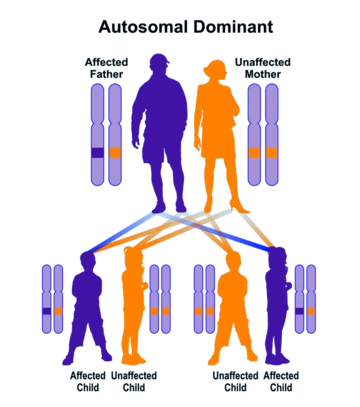
Autosomal dominant inheritance leads to a vertical pattern of transmission