


OMIM ID:
Kenny-Caffey Syndrome, Type 2
Alternate Names
Defective Genes
Clinical Characteristics
Ocular Features
Congenital cataracts have been reported in one patient. There is a report of pseudopapilledema in a 6 year old and another patient has been described with tortuous and dilated retinal vessels. The hyperopia is likely the result of the small globes. In an autopsied patient microscopic calcification was noted in the cornea and the retina.
Systemic Features
Hypocalcemia and hyperphosphatemia similar to hypoparathyroidism is seen in individuals with KCS2 but it may be transient and self-limited. Macrocephaly with short stature is characteristic. Alopecia, delayed closure of the anterior fontanel, and apparent thickening of the cortex in long bones may be seen. Males have small testicles but there is no evidence regarding fertility. In an autopsied case no parathyroid tissue could be identified. Brain imaging may show calcification in the basal ganglia, dentate nuclei, and parts of the cerebrum and cerebellum. Intelligence is normal.
Genetics
Inheritance
Several heterozygous mutations in the FAM111A gene (11q12.1) have been found. Many of these seem to be new mutations but there are a number of published families in which there was transmission from mother to child (of both sexes).
Heterozygous mutations in the same gene are responsible for the autosomal dominant allelic disorder known as Gracile Bone Dysplasia (602361).
Pedigree
Autosomal dominant
Autosomal dominant disorders require only one mutation for the disease to be expressed. Since an affected parent has two chromosomes, only one of which has the mutant gene, parents can expect that half (50%) of their children will receive that one and inherit the disease. It is common for individuals that inherit the mutation, however, to not have evidence of the disease (nonpenetrance).
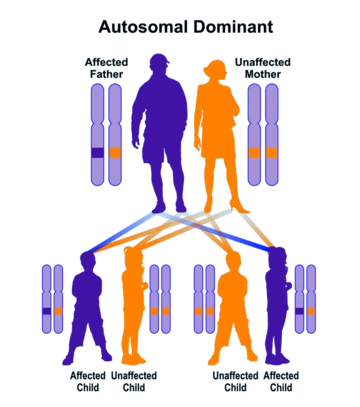
Autosomal dominant inheritance leads to a vertical pattern of transmission