


OMIM ID:
Iridogoniodysgenesis, Type 1
Alternate Names
Defective Genes
Clinical Characteristics
Ocular Features
Glaucoma often develops in the latter part of the first decade of life but has been diagnosed in the neonatal period. It affects at least half of patients with IRID1. The disorder may be suspected in at-risk families by the hypoplasia of the iris stroma resulting in a dark chocolate color with prominent vessels. The irides may also have a dark slate gray color. Further, the anterior iris surface appears smooth without the usual crypts. There are no defects in the pigment layer of the iris, and the sphincter is intact while the pupil is in the normal position. In many patients the iris is inserted anteriorly with numerous iris processes spanning the angle and inserting into the Schwalbe line. In yet other patients tissue seems to fill the angle obscuring other anatomical structures.
Systemic Features
Systemic signs and symptoms are usually absent although CNS imaging has revealed cerebellar vermis hypoplasia in one family.
Genetics
Inheritance
This type of iridogoniodysgenesis results from alterations in the forkhead transcription factor gene (FOXC1) (6p25.3). It is inherited in an autosomal dominant pattern. Rare individuals may have deletions in the 6p area while duplications in FOXC1 are more common than point mutations.
Mutations in the same gene may also be responsible for Axenfeld-Rieger syndrome type 3 (602482), Peters anomaly (604229), and anterior segment mesenchymal dysgenesis (107250).
Another iridogoniodysgenesis disorder (IRID2) (137600) is caused by mutations in the PITX2 gene (4q25-q26), while iridogoniodysgenesis and skeletal anomalies (609515) is an autosomal recessive disorder due to as yet unknown mutations.
Pedigree
Autosomal dominant
Autosomal dominant disorders require only one mutation for the disease to be expressed. Since an affected parent has two chromosomes, only one of which has the mutant gene, parents can expect that half (50%) of their children will receive that one and inherit the disease. It is common for individuals that inherit the mutation, however, to not have evidence of the disease (nonpenetrance).
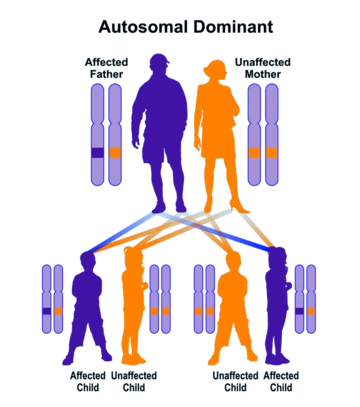
Autosomal dominant inheritance leads to a vertical pattern of transmission