


OMIM ID:
Intellectual Disability with Dysmorphic Facies and Ptosis
Alternate Names
Defective Genes
Clinical Characteristics
Ocular Features
The eyes appear widely spaced and the lid fissures slant downward. Ptosis and blepharophimosis are present. Strabismus is an uncommon feature.
Systemic Features
The characteristic facial profile (round, flat) is evident at birth. Microcephaly has been seen in some children. Low birthweight is common. Most infants feed poorly with general growth delay and short stature becoming evident in childhood. Hypotonia and joint hypermobility are constant features. Gross and fine motor movements appear uncoordinated. Expressive language is delayed and impaired. Intellectual disability is mild and achievement of developmental milestones may be delayed. Seizures are seen in about half of affected individuals. Brain MRIs may reveal mild white matter anomalies. Spinal fusion among cervical vertebrae is common.
Individuals may live to adulthood.
Genetics
Inheritance
Heterozygous mutations in the BRPF1 gene (3p25) are responsible for this condition.
Pedigree
Autosomal dominant
Autosomal dominant disorders require only one mutation for the disease to be expressed. Since an affected parent has two chromosomes, only one of which has the mutant gene, parents can expect that half (50%) of their children will receive that one and inherit the disease. It is common for individuals that inherit the mutation, however, to not have evidence of the disease (nonpenetrance).
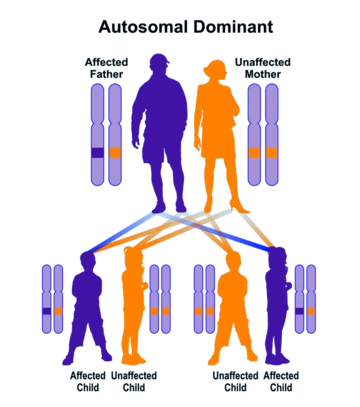
Autosomal dominant inheritance leads to a vertical pattern of transmission