


OMIM ID:
Facial Palsy, Congenital, with Ptosis and Velopharyngeal Dysfunction
Alternate Names
Defective Genes
Clinical Characteristics
Ocular Features
The singular ocular feature found in this condition is congenital bilateral non-progressive ptosis which may improve to some extent with age. Patients usually compensate with a chin up posture. A mild paresis of upgaze and some weakness of the orbicularis oculi muscles has been described in the index case. Ocular motility is otherwise normal and Bell’s phenomenon is usually present.
Systemic Features
Patients have a wide uvula, absent or decreased gag reflexes, and rhinophonia aperta. Symptoms are nonprogressive but may improve with age or therapy. No other skeletal, neurologic, or psychomotor anomalies have been reported.
Genetics
Inheritance
A single 5 generation family has been reported. The transmission pattern is consistent with autosomal dominant inheritance. Heterozygous missense mutations in the TUBB6 gene (18p11.21) are responsible for this condition.
Pedigree
Autosomal dominant
Autosomal dominant disorders require only one mutation for the disease to be expressed. Since an affected parent has two chromosomes, only one of which has the mutant gene, parents can expect that half (50%) of their children will receive that one and inherit the disease. It is common for individuals that inherit the mutation, however, to not have evidence of the disease (nonpenetrance).
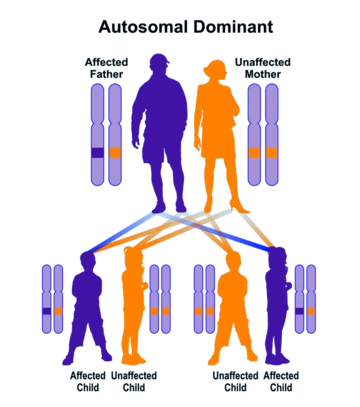
Autosomal dominant inheritance leads to a vertical pattern of transmission