


OMIM ID:
External Ophthalmoplegia, Facial Weakness, and Malignant Hyperthermia
Alternate Names
Defective Genes
Clinical Characteristics
Ocular Features
A subset of patients with malignant hyperthermia susceptibility (MHS) secondary to mutations in RYR1 has congenital ophthalmoplegia and ptosis. Magnetic resonance imaging may reveal hypoplasia of extraocular muscles and intraorbital cranial nerves.
Systemic Features
The weakness in extraocular and levator muscles is sometimes associated with more generalized myopathy of a variable degree. The myopathy may be progressive and individuals with extensive skeletal muscle weakness may have respiratory insufficiency and scoliosis. The clinical spectrum is broad and there is no consistent pattern in the degree of skeletal muscle weakness associated with ocular muscle involvement. This may be explained in part by the variety of myopathies found among patients with mutations in RYR1 such as: central core disease, multiminicore disease, congenital fiber type disproportion, centronuclear myopathy, and nemaline myopathy.
Malignant hyperthermia due to mutations in RYR1 is most commonly inherited as an autosomal dominant trait precipitated by exposure to certain volatile anesthetic agents such as halothane, isoflurane, and enflurane used in association with succinylcholine during general anesthesia. Patients may experience acidosis, muscle rigidity, rhabdomyolysis and tachycardia with arrhythmias. Myoglobinuria may lead to renal failure.
Exercise-induced heat stress rarely precipitates malignant hyperthermia.
Genetics
Inheritance
Ptosis, ophthalmoplegia, and susceptibility to malignant hyperthermia can occur as separate heritable conditions and it is uncommon for them to coexist as in the MHS1 syndrome described here. Due to the heterogeneous signs of muscle disease reported among and between families, it is likely that MHS1 consists of more than one disorder. Mutations in RYR1 are commonly associated with susceptibility to malignant hyperthermia while the co-occurrence of skeletal muscle disease is inconsistent and involvement of extraocular muscles is even rarer.
There is good evidence that at least 6 types of MHS exist. A large number of responsible mutations in 2 genes, RYR1 (19q13.2) and CACNA1S (1q32.1), have been identified and there is good evidence that at least 4 additional loci exist. Mutations in RYR1 are responsible for MHS1 and account for approximately 70% of susceptible individuals. Families with both autosomal dominant and autosomal recessive inheritance patterns have been reported.
It is not understood why some families with MHS1 have ocular and skeletal muscle abnormalities while others do not. External ophthalmoplegia is most often secondary to mutations in mitochondrial DNA but the importance of presurgical recognition of the risk of malignant hyperthermia suggests that pre-surgery gene screening for RYR1 in such patients is warranted.
Pedigree
Autosomal dominant
Autosomal dominant disorders require only one mutation for the disease to be expressed. Since an affected parent has two chromosomes, only one of which has the mutant gene, parents can expect that half (50%) of their children will receive that one and inherit the disease. It is common for individuals that inherit the mutation, however, to not have evidence of the disease (nonpenetrance).
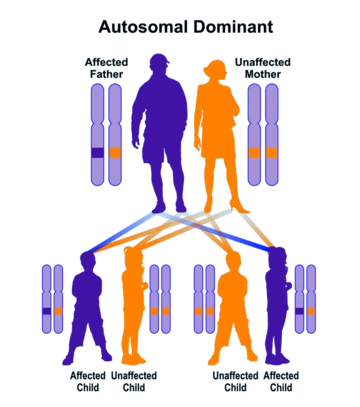
Autosomal dominant inheritance leads to a vertical pattern of transmission
Autosomal recessive
In order for autosomal recessive disorders to be expressed, offspring generally must inherit two mutations, one from each carrier parent. Carriers with only one mutation, such as the parents, do not have clinical disease. Note that carrier parents can expect that 1 in 4 children (25%) will inherit both mutations and have the disorder, 2 in 4 children (50%) will be carriers like their parents, while 1 in 4 children (25%) inherit neither mutation.

In order for autosomal recessive disorders to be expressed, offspring generally must inherit two mutations, one from each carrier parent. Carriers with only one mutation, such as the parents, do not have clinical disease. Note that carrier parents can expect that 1 in 4 children (25%) will inherit both mutations and have the disorder, 2 in 4 children (50%) will be carriers like their parents, while 1 in 4 children (25%) inherit neither mutation.