


OMIM ID:
Corneal Dystrophy, Fuchs Endothelial, Early Onset
Alternate Names
Defective Genes
Clinical Characteristics
Ocular Features
This is one of several adult onset corneal endothelial dystrophy (see Fuchs endothelial corneal dystrophy, late onset, (610158) for more forms of adult Fuchs endothelial dystrophy). The onset of this type is considerably earlier than in the more common adult onset type (610158) . Endothelial disease has been noted as early as three years of age but onset is likely later than in the congenital forms (CHED1; 121700), (CHED2; 217700). In early onset Fuchs dystrophy, most individuals have evident disease by the third and fourth decades and many have advanced disease by the fourth and fifth decades. The sex ratio among affected individuals is closer to 1:1 in this disorder compared with the more common adult onset type in which the disease is more common in females.
In this early onset disorder the guttae are small and more rounded than those in the later onset endothelial dystrophies, and are closer to the center of the endothelial cells. The progression of corneal decompensation is temporally similar to that of the late onset dystrophies, resulting in clinically advanced disease within 3 to 4 decades. The progression of disease has been documented through quantifying the number of guttae over time. Among 26 patients, the number increased as much as 29.1% over a 30 month period, and an exponential increase was noted after age 50 years. The inferotemporal quadrant of the cornea had the greatest proportion of guttae. As in other forms of endothelial corneal dystrophy, Descement’s membrane is thickened and exhibits nodularity with secondary apoptosis of endothelial cells.
Systemic Features
None have been reported.
Genetics
Inheritance
A mutation in the COL8A2 gene, L450W, located on chromosome 1 (1p34.3-p32.3) seems to be responsible for this disease. The gene codes for the alpha-2 chain of collagen VIII which is an important component of Descemet’s membrane. Like many other collagen diseases, this disorder is transmitted as an autosomal dominant.
This gene is also mutant in posterior polymorphous corneal dystrophy 2 (609140) and both types of dystrophy have been reported in the same family suggesting they may be the same disorder with variable expressivity.
Pedigree
Autosomal dominant
Autosomal dominant disorders require only one mutation for the disease to be expressed. Since an affected parent has two chromosomes, only one of which has the mutant gene, parents can expect that half (50%) of their children will receive that one and inherit the disease. It is common for individuals that inherit the mutation, however, to not have evidence of the disease (nonpenetrance).
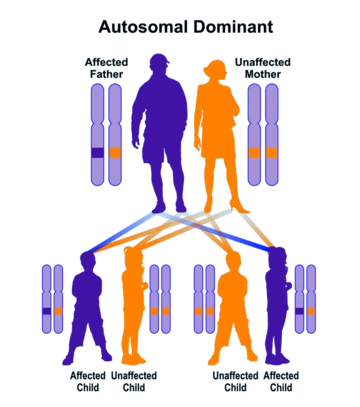
Autosomal dominant inheritance leads to a vertical pattern of transmission