


OMIM ID:
Blepharocheilodontic Syndrome 1
Alternate Names
Defective Genes
Clinical Characteristics
Ocular Features
The eyelids are disproportionately large with an associated lagophthalmos and lower lid ectropion. The upper eyelids may have a double row of lashes (distichiasis). Hypertelorism and a broad nasal root have been reported.
Systemic Features
A cleft lip and palate are major features and are usually bilateral. The teeth are conically shaped with microdontia and oligodontia (involving both primary and secondary dentition) often present as well. Several newborns have had an imperforate anus. Scalp hair may be sparse and hypoplastic nails have been described. Hypothyroidism and thyroid agenesis has been documented in several patients.
Genetics
Inheritance
This is an autosomal dominant condition resulting from mutations in the CDH1 gene (16q22.1).
Blepharocheilodontic syndrome 2 is caused by mutations in the CTNND1 gene (16q22.1).
Other conditions with distichiasis include Blatt distichiasis (126300) and lymphedema-distichiasis (153400).
Pedigree
Autosomal dominant
Autosomal dominant disorders require only one mutation for the disease to be expressed. Since an affected parent has two chromosomes, only one of which has the mutant gene, parents can expect that half (50%) of their children will receive that one and inherit the disease. It is common for individuals that inherit the mutation, however, to not have evidence of the disease (nonpenetrance).
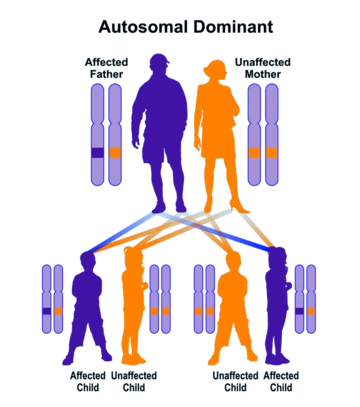
Autosomal dominant inheritance leads to a vertical pattern of transmission