


OMIM ID:
Blatt Distichiasis
Clinical Characteristics
Ocular Features
Distichiasis, or two rows of eyelashes, is sometimes confused with districhiasis (three rows of lashes) or trichiasis. True distichiasis often occurs in all four lids and is sometimes associated with other lid anomalies such as ptosis, trichiasis, corneal damage, congenital ectropion and absence of Meibomian glands. It has occasionally been found only in the lower lids and much more rarely just in the upper lids. In distichiasis, the second row of lashes emerges from the orifices of the Meibomian glands which distinguishes it from acquired trichiasis in which the normally placed lashes are misdirected. The abnormal lashes are usually thinner, shorter, and less pigmented than the normal lashes. They number from 3-20 with an average of 12-15.
Systemic Features
No consistent systemic associations have been reported.
Genetics
Inheritance
Pedigrees consistent with autosomal dominant inheritance have been reported but no locus or gene has been identified.
A Chinese family with affected father and one affected male and female offspring has been reported with distichiasis but no lymphedema. A premature stop codon was found in the FOXC2 transcription gene (16q24.1) in these family members suggesting that they may have had the lymphedema-distichiasis syndrome (153400) instead.
In some patients with anhidrotic ectodermal dysplasia (224900) there is also a double row of lashes but these exit anterior to the Meibomian gland orifices.
Distichiasis also occurs as part of the lymphedema-distichiasis syndrome (153400) as well as the blepharocheilodontic syndrome (119580). Aberrant rows of eyelashes have been reported in Setleis syndrome (227260).
Pedigree
Autosomal dominant
Autosomal dominant disorders require only one mutation for the disease to be expressed. Since an affected parent has two chromosomes, only one of which has the mutant gene, parents can expect that half (50%) of their children will receive that one and inherit the disease. It is common for individuals that inherit the mutation, however, to not have evidence of the disease (nonpenetrance).
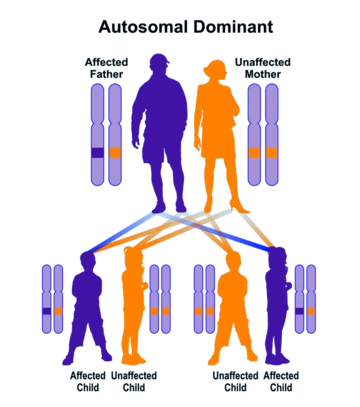
Autosomal dominant inheritance leads to a vertical pattern of transmission