


OMIM ID:
Axenfeld-Rieger Anomaly, Plus
Alternate Names
Defective Genes
Clinical Characteristics
Ocular Features
This rare disorder has ocular features of Rieger anomaly with significant systemic features but different than those found in the Axenfeld-Rieger syndrome. The iris is hypoplastic and the pupil may be distorted secondary to anterior synechiae. Schwalbe line is prominent. There are no reports of glaucoma but this may be biased by the small number of patients reported. Hypertelorism, prominent eyes and strabismus have been described. Several patients have had absence of the extraocular muscles.
Systemic Features
Hypotonia, lax joints, midface hypoplasia, prominent forehead, and short stature have been described. Some, but not all patients have a degree of psychomotor retardation. Mild hearing impairment has been reported.
Genetics
Inheritance
This is likely an autosomal dominant disorder in which mutations of the PITX2 and FOXC1 genes common in Axenfeld-Rieger syndrome have been ruled out. No locus has been identified.
Pedigree
Autosomal dominant
Autosomal dominant disorders require only one mutation for the disease to be expressed. Since an affected parent has two chromosomes, only one of which has the mutant gene, parents can expect that half (50%) of their children will receive that one and inherit the disease. It is common for individuals that inherit the mutation, however, to not have evidence of the disease (nonpenetrance).
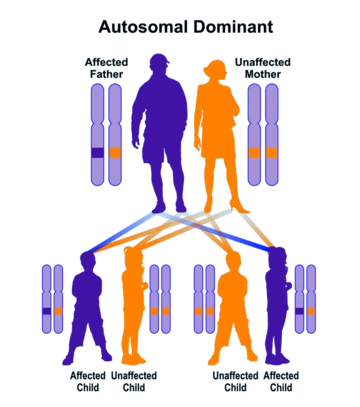
Autosomal dominant inheritance leads to a vertical pattern of transmission