


OMIM ID:
Goldenhar Syndrome Spectrum
Alternate Names
Defective Genes
Clinical Characteristics
Ocular Features
There is considerable clinical heterogeneity in this syndrome. Upper eyelid colobomas and ocular dermoids or lipdermoids are the primary ocular signs (lower lid colobomas are more common in Treacher Collins-Franceschetti syndrome [154500]). The caruncles may be dysplastic, displaced or even bilobed. Iris, optic nerve and chorioretinal colobomas also occur. Microphthalmia is uncommon. All ocular features are usually unilateral but are bilateral in a minority of cases.
Systemic Features
The facial asymmetry (hemifacial microsomia) can be a striking feature. The side with microsomia may have a malformed external auricle, preauricular tags, pretragal fistulas, and microtia or even atresia of the external auditory canal. A wide variety of other anomalies are often found including left lip and palate, mandibular hypoplasia, vertebral anomalies, facial nerve paralysis, congenital heart defects, and conductive hearing loss. Mental deficits are often present along with features of the autism spectrum in 11%.
Genetics
Inheritance
Most cases are sporadic but other family patterns support autosomal recessive and autosomal dominant inheritance with the latter being the most common. A locus at 14q32 has been associated with OAVS but so far no mutant gene has been identified.
Pedigree
Autosomal dominant
Autosomal dominant disorders require only one mutation for the disease to be expressed. Since an affected parent has two chromosomes, only one of which has the mutant gene, parents can expect that half (50%) of their children will receive that one and inherit the disease. It is common for individuals that inherit the mutation, however, to not have evidence of the disease (nonpenetrance).
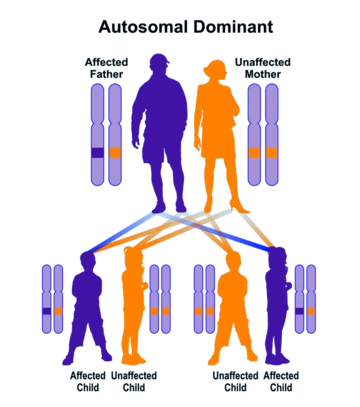
Autosomal dominant inheritance leads to a vertical pattern of transmission