


Goldenhar Syndrome Spectrum
Patient Information
Characteristics
Background and History
This disorder was named for Maurice Goldenhar, an American physician who emigrated from Belgium.
Clinical Correlations
The constellation of anomalies is considered to constitute a spectrum of disease and it may well be that more than one condition is involved. At any rate, there is a wide range of anomalies and degree of severity. One of the outstanding and apparent signs is asymmetry of the face with one side being smaller than the other. The involved side may also have an abnormally small or misshapen external ear, the canal may be small or nonexistent, and there is often a small tag in front of the ear with or without a small hole associated. There may be a split in the eyelid on the same side and often there is a small benign growth on the white part of the eye. Facial, ocular, and auricular features may be unilateral or bilateral. Vertebrae are often malformed. Some degree of deafness is common. Congenital heart defects, cleft lip and/or palate and a misshapen jaw have also been described. A small number of patients have some mental deficit and autism can be a feature.
Genetics
Inheritance
The inheritance of Goldenhar spectrum is uncertain. Most cases occur sporadically, that is, without a family history. However, families with autosomal recessive and autosomal dominant patterns have been reported with the latter being most common. Because the signs may be subtle and minor in many people, it is likely that affected relatives are often missed. No gene mutation has been identified.
Pedigree
Autosomal dominant
Autosomal dominant disorders require only one mutation for the disease to be expressed. Since an affected parent has two chromosomes, only one of which has the mutant gene, parents can expect that half (50%) of their children will receive that one and inherit the disease. It is common for individuals that inherit the mutation, however, to not have evidence of the disease (nonpenetrance).
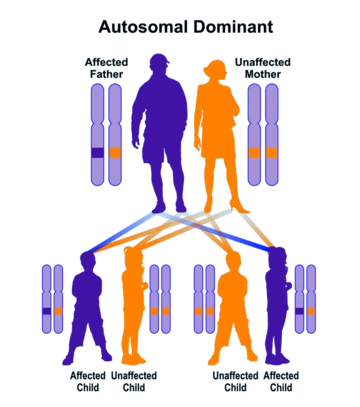
Autosomal dominant inheritance leads to a vertical pattern of transmission
Autosomal recessive
In order for autosomal recessive disorders to be expressed, offspring generally must inherit two mutations, one from each carrier parent. Carriers with only one mutation, such as the parents, do not have clinical disease. Note that carrier parents can expect that 1 in 4 children (25%) will inherit both mutations and have the disorder, 2 in 4 children (50%) will be carriers like their parents, while 1 in 4 children (25%) inherit neither mutation.

In order for autosomal recessive disorders to be expressed, offspring generally must inherit two mutations, one from each carrier parent. Carriers with only one mutation, such as the parents, do not have clinical disease. Note that carrier parents can expect that 1 in 4 children (25%) will inherit both mutations and have the disorder, 2 in 4 children (50%) will be carriers like their parents, while 1 in 4 children (25%) inherit neither mutation.
Diagnosis and Prognosis
The diagnosis requires a multidisciplinary team of pediatricians, otolaryngologists, audiologists, and orthopedists. The lack of specific diagnostic criteria makes definitive diagnosis difficult in many individuals. The prognosis is excellent in mildly affected cases but those with more severe features may require medical monitoring and cosmetic surgery. Scoliosis is a risk that should be monitored as well. Assistive hearing devices may be of benefit.
Web Resources
Printer Friendly Version: Ctrl/Cmd+P