


McCune-Albright Syndrome
Patient Information
Characteristics
Background and History
This disorder was described by a New York pediatrician. Donovan McCune, and an endocrinologist, Fuller Albright, early in the 20th century.
Clinical Correlations
The McCune-Albright syndrome, or Albright disease, is disorder of bone, skin, and endocrine gland dysfunction. It has widespread effects on the body as a result of abnormal functioning hormonal glands including the thyroid, pituitary, adrenal, and sex glands. This causes bony overgrowth including those of the skull which causes narrowing of the tunnel through which the optic nerve passes. When the optic nerve is compressed as a result, it can cause blindness. Hearing may be affected by the same mechanism. However, all bones of the body are affected causing multiple deformities. The skin develops large pigmented patches called café-au-lait spots. Often there is considerably asymmetry of lesions and bony overgrowth between the two sides of the body. Early puberty may occur in both sexes. The metabolic basis of these effects remains unknown.
Genetics
Inheritance
This is generally not a familial disorder although several large pedigrees of individuals that may have had this disorder have been reported and these suggest autosomal dominant inheritance. Even though this is generally not a heritable disorder, a single mutant gene is involved. Mutation occurs early in development so that only some cells carry the mutant gene. The variable clinical picture results from the differences in number and location of cells among individuals in whom the mutation happened. The mutation is seldom passed on to offspring.
Pedigree
Autosomal dominant
Autosomal dominant disorders require only one mutation for the disease to be expressed. Since an affected parent has two chromosomes, only one of which has the mutant gene, parents can expect that half (50%) of their children will receive that one and inherit the disease. It is common for individuals that inherit the mutation, however, to not have evidence of the disease (nonpenetrance).
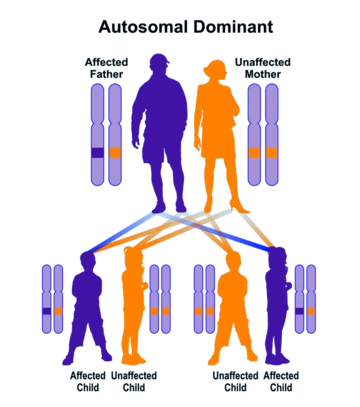
Autosomal dominant inheritance leads to a vertical pattern of transmission
Diagnosis and Prognosis
This complex disorder requires a multidisciplinary team for diagnosis and treatment. Therapy for different problems is specific and no single treatment is available for all aspects of McCune-Albright syndrome.
Web Resources
Printer Friendly Version: Ctrl/Cmd+P