


Clinical Characteristics
Ocular Features
The combination of corneal guttata and anterior polar cataracts has been reported in at least 4 multigenerational families. Cataracts have their onset in the first decade of life, sometimes as early as 6 months but often are not noted until 3 to 4 years of age. The polar opacities range in size from that of a small dot to 3 mm in diameter. These progress slowly and become nearly stationary in early adulthood but can progress sufficiently to interfere with acuity and sometimes require removal by the 3rd or 4th decades of life. The guttata also appear sometime after birth and are more pronounced centrally. Histologically the stroma is normal but the epithelium shows some edematous changes and the Descemet membrane progressively thickens with age along with the corneal clouding. Visual impairment early is generally caused by the lens opacity while later in life corneal edema is more likely the cause.
Vision across a variety of ages ranges from 20/20 to 20/40 in patients with more stationary disease.
Systemic Features
No associated systemic disease has been reported.
Genetics
Inheritance
This is a presumed autosomal dominant disorder resulting from heterozygous mutations in the TMCO3 gene (13q34).
Another type of autosomal dominant anterior polar cataract, CTAA2 (601202), but without corneal disease has been mapped to 17p13 and yet another (CTAA1) (115650) is associated with chromosomal aberrations.
Pedigree
Autosomal dominant
Autosomal dominant disorders require only one mutation for the disease to be expressed. Since an affected parent has two chromosomes, only one of which has the mutant gene, parents can expect that half (50%) of their children will receive that one and inherit the disease. It is common for individuals that inherit the mutation, however, to not have evidence of the disease (nonpenetrance).
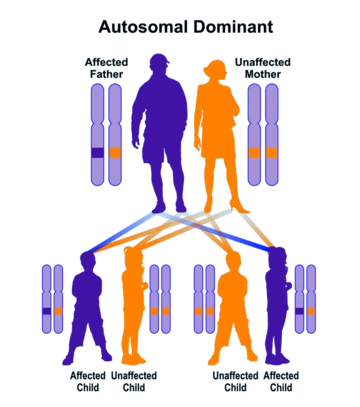
Autosomal dominant inheritance leads to a vertical pattern of transmission