


OMIM ID:
SHORT Syndrome
Alternate Names
Defective Genes
Clinical Characteristics
Ocular Features
Deeply set eyes are frequently noted and perhaps are a result of the lipodystrophy. Anterior segment abnormalities resembling Rieger anomalies are often associated with congenital glaucoma.
Systemic Features
There is considerable clinical heterogeneity. The facial gestalt, however, is said to be characteristic. These are: triangular progeroid facies with a prominent forehead, absence of facial fat, midface hypoplasia, and hypoplastic nasal alae. Insulin resistance seems to be a consistent feature as well and nephrocalcinosis is common. Serum and urinary calcium may be elevated even in infancy.
Teeth are late to erupt and bone age is delayed with shortness of stature the final result in many cases. Joints are often hyperextensible. A neurosensory hear loss has been found in some individuals. Notably, developmental milestones are usually timely although mild cognitive delays are rarely seen and speech may be delayed. Inguinal hernias are part of the syndrome.
Genetics
Inheritance
Heterozygous mutations in the PIK3R1 gene (5q31.1) are responsible for this syndrome.
Pedigree
Autosomal dominant
Autosomal dominant disorders require only one mutation for the disease to be expressed. Since an affected parent has two chromosomes, only one of which has the mutant gene, parents can expect that half (50%) of their children will receive that one and inherit the disease. It is common for individuals that inherit the mutation, however, to not have evidence of the disease (nonpenetrance).
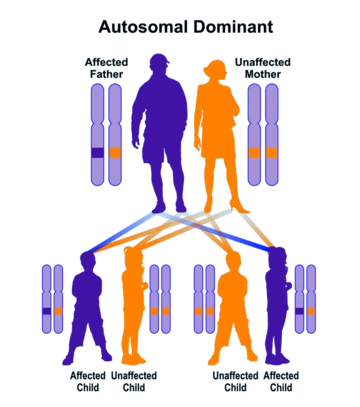
Autosomal dominant inheritance leads to a vertical pattern of transmission