


Clinical Characteristics
Ocular Features
Strabismus and/or ophthalmoplegia are important features of a group of conditions known as cranial dysinnervation disorders. Ptosis, Duane syndrome, V pattern exotropia and various degrees of ophthalmoplegia may be seen. There may be considerable asymmetry in the manifestations in the two eyes. Epicanthal folds, blepharophimosis, and hypermetropia are sometimes present. Some patients have corneal leukomas, keratoglobus, high corneal astigmatism, and dysplastic optic disks.
A pigmentary retinopathy and folds in the macula with an abnormal ERG has been reported. Subnormal vision has been reported in some patients.
Systemic Features
Patients are often short in stature with pectus excavatum, spine stiffness, highly arched palate, and club feet. Limited forearm rotation and wrist extension may be present. The fingers appear long and often have contractures while the palmar and phalangeal creases may be absent. Camptodactyly and clinodactyly are common. Deep tendon reflexes are often hyporeactive and decreased muscle mass has been noted. The muscles seem "firm" to palpation. Restrictive lung disease has been reported. Hearing loss is experienced by some individuals.
Genetics
Inheritance
Distal arthrogryposis type 5D is caused by homozygous or compound heterozygous mutations in the ECEL1 gene located at 2q36. However, a similar phenotype (albeit with more severe ocular manifestations) results from heterozygous mutations in PIEZO2 (18p11). Heterozygous mutations in the PIEZO2 gene have also been reported to cause distal arthrogryposis type 3 (Gordon syndrome [114300]) and Marden-Walker syndrome (248700) and all of these may be simply phenotypical variations of the same disorder.
Pedigree
Autosomal dominant
Autosomal dominant disorders require only one mutation for the disease to be expressed. Since an affected parent has two chromosomes, only one of which has the mutant gene, parents can expect that half (50%) of their children will receive that one and inherit the disease. It is common for individuals that inherit the mutation, however, to not have evidence of the disease (nonpenetrance).
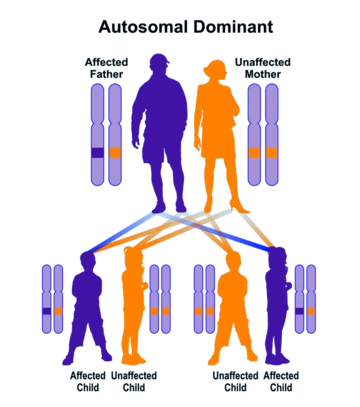
Autosomal dominant inheritance leads to a vertical pattern of transmission
Autosomal recessive
In order for autosomal recessive disorders to be expressed, offspring generally must inherit two mutations, one from each carrier parent. Carriers with only one mutation, such as the parents, do not have clinical disease. Note that carrier parents can expect that 1 in 4 children (25%) will inherit both mutations and have the disorder, 2 in 4 children (50%) will be carriers like their parents, while 1 in 4 children (25%) inherit neither mutation.

In order for autosomal recessive disorders to be expressed, offspring generally must inherit two mutations, one from each carrier parent. Carriers with only one mutation, such as the parents, do not have clinical disease. Note that carrier parents can expect that 1 in 4 children (25%) will inherit both mutations and have the disorder, 2 in 4 children (50%) will be carriers like their parents, while 1 in 4 children (25%) inherit neither mutation.