


Nanophthalmos AD
Patient Information
Characteristics
Background and History
In this condition the eyeball is abnormally small. It is one of several such disorders but the only one that is inherited in an autosomal dominant pattern.
Clinical Correlations
Because the eyeball is shortened, patients are farsighted to a severe degree. There are also other malformations including several that impact the normal circulation of fluid in the eye which increases the risk of a sudden onset and painful form of glaucoma known as angle closure glaucoma. Vision can be normal, at least in younger individuals but many older persons may have severe loss of sight.
The gene mutation which is responsible for this condition does not seem to cause other health problems.
Genetics
Inheritance
This type of nanophthalmos is inherited in an autosomal dominant pattern. Parents with this condition can expect that half of their children will inherit the same disorder.
Pedigree
Autosomal dominant
Autosomal dominant disorders require only one mutation for the disease to be expressed. Since an affected parent has two chromosomes, only one of which has the mutant gene, parents can expect that half (50%) of their children will receive that one and inherit the disease. It is common for individuals that inherit the mutation, however, to not have evidence of the disease (nonpenetrance).
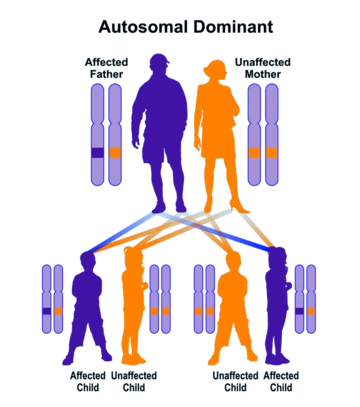
Autosomal dominant inheritance leads to a vertical pattern of transmission
Diagnosis and Prognosis
The diagnosis is usually made by an ophthalmologist based on an eye examination. Most individuals live normal lives if their farsightedness is corrected with glasses or contact lenses. However, periodic examinations are necessary throughout their lifespan since there always remain the risk of developing acute glaucoma which requires emergency surgery to prevent blindness.
Printer Friendly Version: Ctrl/Cmd+P