


Clinical Characteristics
Ocular Features
Noonan syndrome has prominent anomalies of the periocular structures including downward-slanting lid fissures, hypertelorism, epicanthal folds, high upper eyelid crease, and some limitation of ocular mobility most commonly of the levator. Ptosis and strabismus are present in nearly half of patients. Amblyopia has been found in one-third of patients and almost 10% have nystagmus. Corneal nerves are prominent and a substantial number of individuals have optic nerve abnormalities including drusen, hypoplasia, colobomas and myelinated nerves. Evidence of an anterior stromal dystrophy, cataracts, or panuveitis is seen in a minority of patients. About 95% of patients have some ocular abnormalities.
Systemic Features
Patients are short in stature. Birth weight and length may be normal but lymphedema is often present in newborns. The neck is usually webbed (pterygium colli) and the ears low-set. The sternum may be deformed. Cardiac anomalies such as coarctation of the aorta, pulmonary valve stenosis, hypertrophic cardiomyopathy, and septal defects are present in more than half of patients. Dysplasia of the pulmonic valve has been reported as well. Thrombocytopenia and abnormal platelet function with abnormalities of coagulation factors are found in about 50% of cases resulting in easy bruising and prolonged bleeding. Cryptorchidism is common in males. Some patients have intellectual disabilities with speech and language problems. Most have normal intelligence.
Parents of affected children often have subtle signs of Noonan Syndrome.
Genetics
Inheritance
This is an autosomal dominant disorder that can result from mutations in at least 8 genes. Nearly half are caused by mutations in the PTPN11 gene (12q24.1) (163950). Mutations in the SOS1 gene (2p22-p21) cause NS4 (610733) and account for 10-20% of cases, those in the RAF1 gene (3p25) causing NS5 (611553) for about the same proportion, and mutations in the KRAS gene (12p12.1) (NS3; 609942) cause about 1%. Mutations in BRAF (7q34) causing NS7 (613706), NRAS (1p13.2) responsible for NS6 (613224), and MEK1 genes have also been implicated and it is likely that more mutations will be found. The phenotype is similar in all individuals but with some variation in the frequency and severity of specific features. New mutations are common.
Several families with autosomal recessive inheritance (NS2) (605275) patterns have been reported with biallelic mutations in LZTR1.
Pedigree
Autosomal dominant
Autosomal dominant disorders require only one mutation for the disease to be expressed. Since an affected parent has two chromosomes, only one of which has the mutant gene, parents can expect that half (50%) of their children will receive that one and inherit the disease. It is common for individuals that inherit the mutation, however, to not have evidence of the disease (nonpenetrance).
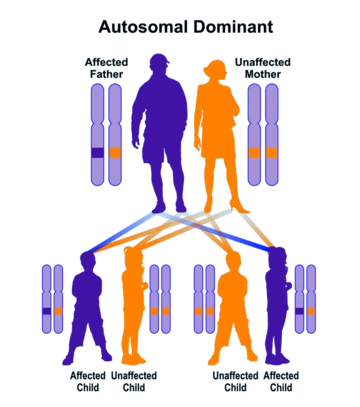
Autosomal dominant inheritance leads to a vertical pattern of transmission
Autosomal recessive
In order for autosomal recessive disorders to be expressed, offspring generally must inherit two mutations, one from each carrier parent. Carriers with only one mutation, such as the parents, do not have clinical disease. Note that carrier parents can expect that 1 in 4 children (25%) will inherit both mutations and have the disorder, 2 in 4 children (50%) will be carriers like their parents, while 1 in 4 children (25%) inherit neither mutation.

In order for autosomal recessive disorders to be expressed, offspring generally must inherit two mutations, one from each carrier parent. Carriers with only one mutation, such as the parents, do not have clinical disease. Note that carrier parents can expect that 1 in 4 children (25%) will inherit both mutations and have the disorder, 2 in 4 children (50%) will be carriers like their parents, while 1 in 4 children (25%) inherit neither mutation.