


Weill-Marchesani Syndrome 2
Patient Information
Characteristics
Background and History
This is an extremely rare disorder described in the early 1990s. It has many features of the Weill-Marchesani syndrome 1. Glaucoma may be a more important component than in the WM syndrome.
Clinical Correlations
Individuals have glaucoma and lens displacement with progressive joint stiffness and short digits. Skin folds are described as thickened. Individuals have difficulty extending their arms at the elbow as well as fully extending their fingers. Extreme near-sightedness has been reported. One individual had retinal detachments in both eyes resulting in blindness. Short stature is characteristic.
Genetics
Inheritance
This is a presumed autosomal dominant disorder based on one three generation family reported. Affected parents can expect that on average half of their children will have the same disorder.
Pedigree
Autosomal dominant
Autosomal dominant disorders require only one mutation for the disease to be expressed. Since an affected parent has two chromosomes, only one of which has the mutant gene, parents can expect that half (50%) of their children will receive that one and inherit the disease. It is common for individuals that inherit the mutation, however, to not have evidence of the disease (nonpenetrance).
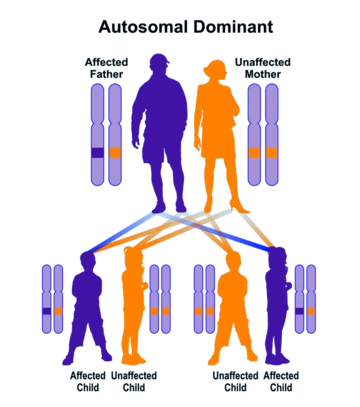
Autosomal dominant inheritance leads to a vertical pattern of transmission
Diagnosis and Prognosis
The major symptoms of this disease involve the eye and eye examinations are recommended throughout life for glaucoma. The lenses displace downward and this event plus the extreme near-sightedness requires that the glasses prescription be checked frequently. One patient had severe glaucoma beginning in early childhood and this must be considered a threat to vision throughout life. Longevity is not impacted.
Web Resources
Printer Friendly Version: Ctrl/Cmd+P