


Vitreoretinopathy with Epiphyseal Dysplasia
Patient Information
Characteristics
Background and History
A number of gene mutations in genes producing collagen, a component of connective tissue, cause combined skeletal and eye problems with many overlapping features.
Clinical Correlations
This disorder causes short fingers and early arthritis, primarily in the fingers of the hand which are described as ‘stubby’. Some patients also have early onset hip disease. The retina and the vitreous (the gel-like material filling the back of the eye) are abnormal as well and together raise the risk of a retinal detachment. This may occur as early as the second decade of life, but the risk lasts throughout life. Stature is normal and no skull or facial abnormalities are seen as they are sometimes in other collagen disorders.
Genetics
Inheritance
Inheritance is direct from parent to child creating a vertical pattern characteristic of autosomal dominant disease.
Pedigree
Autosomal dominant
Autosomal dominant disorders require only one mutation for the disease to be expressed. Since an affected parent has two chromosomes, only one of which has the mutant gene, parents can expect that half (50%) of their children will receive that one and inherit the disease. It is common for individuals that inherit the mutation, however, to not have evidence of the disease (nonpenetrance).
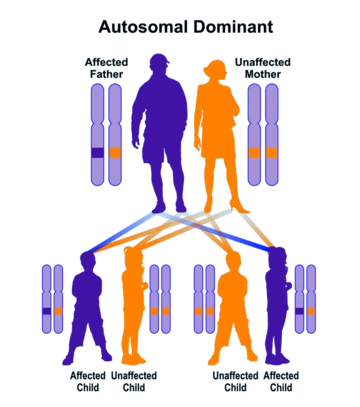
Autosomal dominant inheritance leads to a vertical pattern of transmission
Diagnosis and Prognosis
Ophthalmologists and orthopedists are important to the diagnosis of this rare autosomal dominant disorder. Degenerative disease in large joints such as the hips may require surgical treatment. The hands are usually functional without difficulty. Retinal detachments require prompt repair to maintain vision. Early detection is important to the prognosis and since the risk for a detachment is present throughout life, repeated dilated eye examinations are essential.
Web Resources
Printer Friendly Version: Ctrl/Cmd+P