


Sorsby Pseudoinflammatory Fundus Dystrophy
Patient Information
Characteristics
Background and History
This is a rare progressive disorder of the retina that lines the inside of the eye and responds to light. It is only one of numerous such disorders.
Clinical Correlations
Vision problems have their onset in the second to fourth decades when the macula (the portion of the retina that we use for our sharpest vision) no longer functions normally. However, night vision problems may cause problems before your eye doctor can see changes in the macula indicating that damage to the retina has already occurred. This is a progressive disorder which may lead to severe loss of vision eventually. General health is not affected.
Genetics
Inheritance
This is an autosomal dominant condition in which only a single mutant gene is required to cause disease. It is passed in a vertical pattern directly from parent to child with 50% likelihood for each child.
Pedigree
Autosomal dominant
Autosomal dominant disorders require only one mutation for the disease to be expressed. Since an affected parent has two chromosomes, only one of which has the mutant gene, parents can expect that half (50%) of their children will receive that one and inherit the disease. It is common for individuals that inherit the mutation, however, to not have evidence of the disease (nonpenetrance).
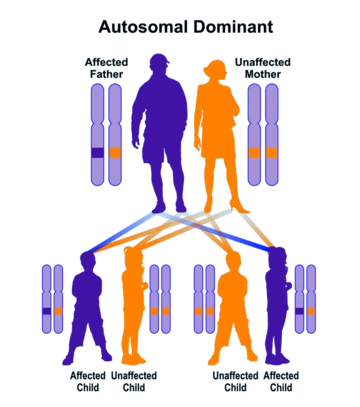
Autosomal dominant inheritance leads to a vertical pattern of transmission
Diagnosis and Prognosis
This disorder is diagnosed by an ophthalmologist based on the appearance of the retina and the course of the disease. Treatment with daily doses of vitamin A can reverse the symptoms of night blindness. Other treatments for the macular degeneration as recommended by your eye doctor may also be beneficial. Low vision aids can be helpful in early stages of the disease.
Printer Friendly Version: Ctrl/Cmd+P