


Sorsby Macular Coloboma Syndrome
Patient Information
Characteristics
Background and History
This rare disorder was described by A. Sorsby in 1935 and only a few cases have been reported since then.
Clinical Correlations
Sorsby macular coloboma syndrome consists of eye and skeletal malformations. Part of the retina (macula) does not develop and, as a result, vision is poor. Nystagmus (dancing eyes) can result from this and vision is reduced to the point where special educational considerations are required.
The skeletal changes are primarily in the fingers, and toes. The thumbs and large toes may be wide and appear to be doubled, and the bones in the fingers may be missing. Fusion between fingers and toes is common. The nails do not develop normally and may be missing. The arms and legs may also be short resulting in some shortness of stature. Mental development is normal. The ears are often prominent and deafness has been found in some patients.
Genetics
Inheritance
This is an autosomal dominant disorder based on pedigree patterns although no responsible gene mutation has been identified. Parents with this disorder may transmit it directly to their children.
Pedigree
Autosomal dominant
Autosomal dominant disorders require only one mutation for the disease to be expressed. Since an affected parent has two chromosomes, only one of which has the mutant gene, parents can expect that half (50%) of their children will receive that one and inherit the disease. It is common for individuals that inherit the mutation, however, to not have evidence of the disease (nonpenetrance).
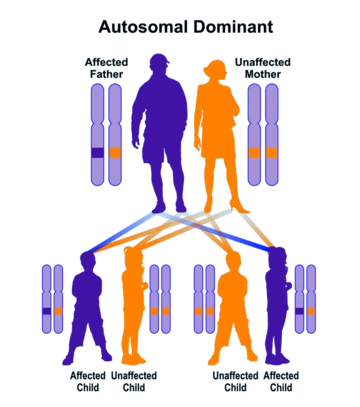
Autosomal dominant inheritance leads to a vertical pattern of transmission
Diagnosis and Prognosis
The skeletal abnormalities are self-evident but an ophthalmologist is needed to visualize the colobomas. X-rays are necessary to determine the nature of bony abnormalities in the fingers and toes. Thus a team approach is needed to document the full syndrome. Lifespan is normal. Assistive hearing and vision devices may be helpful. Orthopedic surgery to correct some of the digital abnormalities can also be beneficial.
Printer Friendly Version: Ctrl/Cmd+P