


Optic Atrophy 4
Patient Information
Characteristics
Background and History
The optic nerve connects the eye to the brain and carries visual signals from the retina that enables us to see. Consequently, any disease that damages this nerve can result in vision loss. A number of gene mutations lead to defects of such nerve conduction which may begin with damage to the nerve cells of the retina.
Clinical Correlations
Type 4 optic atrophy can have its onset in early childhood but also later. The disease is bilateral and often progressive but carriers of the mutation have a wide range of clinical symptoms from none to marked vision loss. Some people experience only a slow loss of vision over years whereas others may experience an acute, rapid decline. Likewise, the appearance of the optic nerve may show no damage but others have a markedly pale appearance indicative of more severe disease. Loss of color vision is often noticeable but not all patients have this. Older individuals generally have worse vision than younger ones but this is highly variable.
Genetics
Inheritance
This is an autosomal dominant disorder meaning there is a vertical pattern of transmission which usually occurs from parent to child. Affected parents have a 50% chance of each child inheriting the same disorder.
Pedigree
Autosomal dominant
Autosomal dominant disorders require only one mutation for the disease to be expressed. Since an affected parent has two chromosomes, only one of which has the mutant gene, parents can expect that half (50%) of their children will receive that one and inherit the disease. It is common for individuals that inherit the mutation, however, to not have evidence of the disease (nonpenetrance).
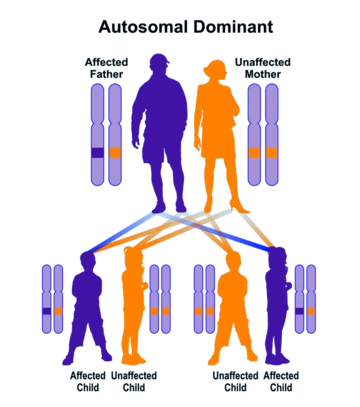
Autosomal dominant inheritance leads to a vertical pattern of transmission
Diagnosis and Prognosis
The diagnosis is usually made by an ophthalmologist or sometimes by a neurologist. The prognosis is highly variable but once the optic nerve is damaged, the vision loss is not reversible. No treatment is available for the optic nerve damage but low vision aids can be helpful for everyday tasks.
Web Resources
Printer Friendly Version: Ctrl/Cmd+P