


Nystagmus-Split Hand Syndrome
Patient Information
Characteristics
Background and History
This rare syndrome was reported by two German physicians, J. Karsch in 1936, and H. Neugebaurer in 1962. Only a few families have been reported since then. The primary signs consist of ‘wandering eyes’ and hand/foot malformations.
Clinical Correlations
Children are born with ‘dancing’ or ‘wandering’ eyes (nystagmus) and mildly reduced vision. There is some evidence that the amount of involuntary eye movements decrease as children grow older. Vision has been reported in a few individuals and is in the range of 20/40 to 20/70. Several older individuals have also been reported to have cataracts with some unknown type of retinal changes.
The malformations in the hands and feet are striking. Often the individual fingers and toes are absent and the entire hand or foot appears split into two major, opposing extensions. This condition is sometimes called ectrodactyly. This may involve all four limbs but the hands are most frequently affected.
Genetics
Inheritance
The genetics are not fully delineated but autosomal dominant inheritance seems most likely. Thus affected parents may expect that on average half their children will have the same condition. However, children with this disorder have also been born to apparently normal parents. No responsible gene mutation has been found.
Pedigree
Autosomal dominant
Autosomal dominant disorders require only one mutation for the disease to be expressed. Since an affected parent has two chromosomes, only one of which has the mutant gene, parents can expect that half (50%) of their children will receive that one and inherit the disease. It is common for individuals that inherit the mutation, however, to not have evidence of the disease (nonpenetrance).
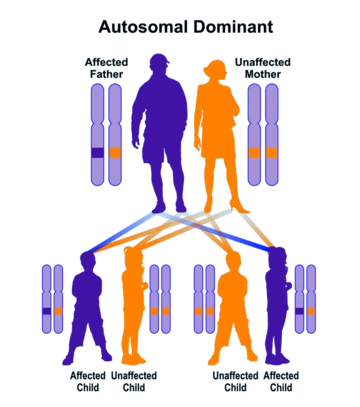
Autosomal dominant inheritance leads to a vertical pattern of transmission
Diagnosis and Prognosis
Orthopedists and geneticists are most likely to make the diagnosis. There is no treatment for the nystagmus but some improvement in hand and foot function may be achieved with surgery. Full normal function and appearance cannot usually be restored, however, since the normal bones are not present.
Printer Friendly Version: Ctrl/Cmd+P