


Macular Dystrophy, Vitelliform 4
Patient Information
Characteristics
Background and History
The macula is a specialized portion of our retinas containing the highest concentration of rods and cones which respond to light and transmit electrical impulses to the brain enabling us to see. Diseases of the macula are of many kinds and some, including this one, occur secondary to gene mutations.
This condition is one of a group of retinal conditions known as vitelliform macular dystrophy, sometimes referred to as Best Disease.
Clinical Correlations
The onset of symptoms usually occurs between the ages of 25 and 40 years. While this is a progressive disorder, progression is slow and many individuals have near normal vision for many years. Only the eyes are involved in this condition and individuals remain healthy otherwise.
Genetics
Inheritance
Mutations in a specific gene are responsible for this condition. Only one mutation is preseent in most people and the transmission pattern is vertical, consistent with autosomal dominant inheritance. In this case affected parents may pass the mutation directly to their children with the expectation that half of their children will eventually manifest the retinal disease.
However, several families have been reported in which symptomatic persons had two copies of the mutation and both their parents (who had no symptoms) carried a single mutation. This is consistent with autosomal recessive inheritance in which each parent contributes one mutation (an event that occurs in 1 out of 4 children).
Pedigree
Autosomal dominant
Autosomal dominant disorders require only one mutation for the disease to be expressed. Since an affected parent has two chromosomes, only one of which has the mutant gene, parents can expect that half (50%) of their children will receive that one and inherit the disease. It is common for individuals that inherit the mutation, however, to not have evidence of the disease (nonpenetrance).
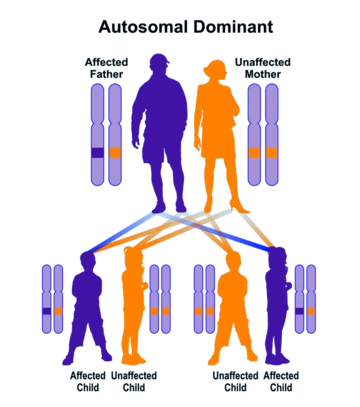
Autosomal dominant inheritance leads to a vertical pattern of transmission
Autosomal recessive
In order for autosomal recessive disorders to be expressed, offspring generally must inherit two mutations, one from each carrier parent. Carriers with only one mutation, such as the parents, do not have clinical disease. Note that carrier parents can expect that 1 in 4 children (25%) will inherit both mutations and have the disorder, 2 in 4 children (50%) will be carriers like their parents, while 1 in 4 children (25%) inherit neither mutation.

In order for autosomal recessive disorders to be expressed, offspring generally must inherit two mutations, one from each carrier parent. Carriers with only one mutation, such as the parents, do not have clinical disease. Note that carrier parents can expect that 1 in 4 children (25%) will inherit both mutations and have the disorder, 2 in 4 children (50%) will be carriers like their parents, while 1 in 4 children (25%) inherit neither mutation.
Diagnosis and Prognosis
This condition is diagnosed by an ophthalmologist (MD eye doctor) based on the symptoms and the appearance of the retina. A fluorescein angiogram (consisting of pictures of the retina following an injection of dye into the circulation) can be helpful in the diagnosis. A special test called an electrooculogram (EOG) may be done as well.
Vision is highly variable among patients and while there is generally some slow loss of vision throughout life, there is much variation of signs and symptoms among individuals. Longevity is not impacted.
No treatment is available for the disease but low vision devices can be helpful, especially for reading and near work.
Web Resources
Printer Friendly Version: Ctrl/Cmd+P