


Fibrosis of Extraocular Muscles, CFEOM3C
Patient Information
Characteristics
Background and History
This is one of several hereditary forms of strabismus (abnormal alignment of the eyes) in which the eye movements are restricted. It is present at birth and nonprogressive. Although the name implies a disease of the muscles that move the eye, the primary disorder is one of maldevelopment of the nerves that supply those muscles.
Clinical Correlations
This unusual condition so far has been reported in one family. The eyelids are droopy (ptotic) at birth and individuals may be unable to look up. Instead, patients need to tilt their heads far back to look ahead. Rotation of the eyes can be abnormal as well.
In 3 affected members of the reported family there were no associated health problems. However, a fourth individual had physical and mental growth problems and was considered mentally retarded.
Genetics
Inheritance
Affected individuals in this family carried a chromosomal aberration in which parts of two chromosomes were exchanged. This so-called translocation was transmitted in an autosomal dominant pattern. Therefore a carrier of the translocation could expect that his offspring would inherit the same condition with a 50% probability.
Pedigree
Autosomal dominant
Autosomal dominant disorders require only one mutation for the disease to be expressed. Since an affected parent has two chromosomes, only one of which has the mutant gene, parents can expect that half (50%) of their children will receive that one and inherit the disease. It is common for individuals that inherit the mutation, however, to not have evidence of the disease (nonpenetrance).
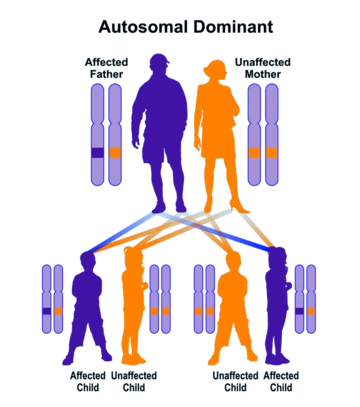
Autosomal dominant inheritance leads to a vertical pattern of transmission
Diagnosis and Prognosis
The drooping eyelids (ptosis) are apparent at birth and the eyes would not look straight ahead. An ophthalmologist and sometimes a neurologist would suspect the diagnosis from the appearance of the infant.
Surgery can often lift the droopy lids but the eyes would remain variably deviated and relatively fixed in position.
Printer Friendly Version: Ctrl/Cmd+P