


External Ophthalmoplegia, ANT1 and mtDNA Mutations
Patient Information
Characteristics
Background and History
This disorder of eye movement was first described by an ophthalmologist, Albrecht Von Graefe, in 1868. A number of genetic disorders cause difficulties in eye movement, known as external ophthalmoplegia. The type described here is largely limited to the eye.
Clinical Correlations
Droopy eyelids (ptosis) and difficulty moving the eyes are first noted at about 20 years of age and are the major symptoms. Some progression occurs. There may be some mild hearing loss, and skeletal muscles are affected little if at all. Vision remains good throughout life.
Genetics
Inheritance
This is an autosomal dominant disease and has been reported primarily in Italian families. It requires only a single mutation and is usually acquired from an affected parent creating a vertical pattern of inheritance.
Pedigree
Autosomal dominant
Autosomal dominant disorders require only one mutation for the disease to be expressed. Since an affected parent has two chromosomes, only one of which has the mutant gene, parents can expect that half (50%) of their children will receive that one and inherit the disease. It is common for individuals that inherit the mutation, however, to not have evidence of the disease (nonpenetrance).
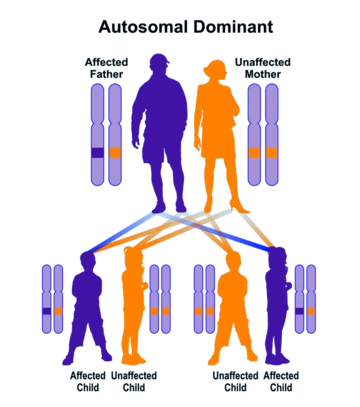
Autosomal dominant inheritance leads to a vertical pattern of transmission
Diagnosis and Prognosis
Opthalmologists and/or neurologists generally make the diagnosis. The prognosis is excellent and lifespan is normal. Eyelid surgery can elevate the droopy eyelids.
Web Resources
Printer Friendly Version: Ctrl/Cmd+P