


Doyne Honeycomb Macular Dystrophy
Patient Information
Characteristics
Background and History
Robert Walter Doyne, an ophthalmologist in England, first described this disorder in 1899. It is sometimes called Malattia Leventinese after it was observed among families living in the Leventine valley in southern Switzerland.
Clinical Correlations
This rare disorder is limited to the retina of the eye where round white lesions appear in a radial fashion around the macula, an area we use for our fine vision since it has a dense concentration of cells that respond to light and transmit images to the brain. In the early stages, vision is minimally impacted but with time slow vision loss takes place. Later, significant vision loss is present. Sometimes, new blood vessels may appear in the area and when these hemorrhage, sudden vision loss occurs. This may result in scarring which leads to severe, permanent vision loss.
Genetics
Inheritance
This is an autosomal dominant disorder in most cases, meaning that the inheritance pattern is vertical as parents can directly transmit the disease to their children.
Pedigree
Autosomal dominant
Autosomal dominant disorders require only one mutation for the disease to be expressed. Since an affected parent has two chromosomes, only one of which has the mutant gene, parents can expect that half (50%) of their children will receive that one and inherit the disease. It is common for individuals that inherit the mutation, however, to not have evidence of the disease (nonpenetrance).
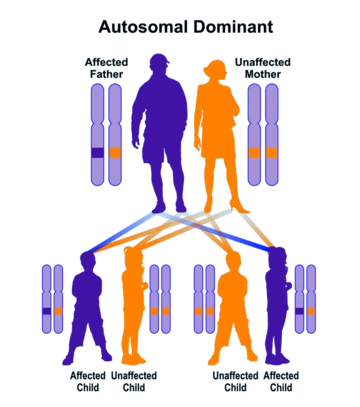
Autosomal dominant inheritance leads to a vertical pattern of transmission
Diagnosis and Prognosis
No treatment is available for the genetic disease but low vision aids are often helpful in restoring near normal visual function for many years.
Web Resources
Printer Friendly Version: Ctrl/Cmd+P