


Corneal Dystrophy, Thiel-Behnke
Patient Information
Characteristics
Background and History
The cornea is the normally clear ‘windshield’ of the eye. A number of gene mutations lead to diseases of this tissue, often called dystrophies (degeneration), and various deposits of abnormal material can accumulate. This type is distinctive for the honeycomb pattern of opacities in the cornea.
Clinical Correlations
Symptoms in the first and second decades of life are primarily due to defects (like scratches) on the surface of the cornea which are painful and slow to heal. Light sensitivity and excessive tearing are often associated with these erosions. The disease is progressive as the cornea becomes increasingly cloudy which, of course, interferes with vision. No other parts of the body seem to be affected.
Genetics
Inheritance
This is an autosomal dominant disorder in which the family pattern of disease is a vertical one as parents pass the mutant gene to half their offspring on average.
Pedigree
Autosomal dominant
Autosomal dominant disorders require only one mutation for the disease to be expressed. Since an affected parent has two chromosomes, only one of which has the mutant gene, parents can expect that half (50%) of their children will receive that one and inherit the disease. It is common for individuals that inherit the mutation, however, to not have evidence of the disease (nonpenetrance).
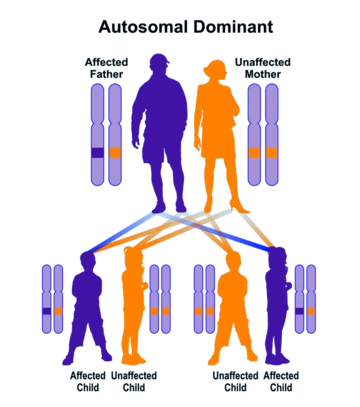
Autosomal dominant inheritance leads to a vertical pattern of transmission
Diagnosis and Prognosis
It may be possible to see a cloudy cornea by simple inspection but only your ophthalmologist can specifically diagnose this type of dystrophy. Various treatments can temporarily alleviate symptoms and improve vision but the corneal clouding often recurs.
Web Resources
Printer Friendly Version: Ctrl/Cmd+P