


Corneal Dystrophy, Epithelial Basement Membrane
Patient Information
Characteristics
Background and History
There are a number of inherited degenerative disorders (or dystrophies) of the cornea (the clear ‘windshield’ of the eye at the front). These result from mutations in several genes and they impact one or more layers of the cornea.
This disorder affects the surface layer of the eye known as the epithelium. Some of the features can be found in up to 75% of older individuals who do not have a corneal dystrophy and do not have a family history of it.
Clinical Correlations
Epithelial basment membrane disease leads to eye irritation, tearing, and some degree of light sensitivity. Vision can be affected as well but usually only to a minor degree. Most patients are asymptomatic unless small scratch-like defects occur on the front surface layer, called the epithelium. Your eye doctor may see diagnostic changes in the first decade of life but symptoms often are not noticed until early adulthood. The tissue damage is progressive with increasing irritation and loss of vision as patients get older and usually both eyes are similarly affected. The corneas sometimes appear cloudy to some extent, especially in older individuals, resulting from deposits or damaged tissue. This process results in opacities which are often small and discrete, appearing as dots or spots on the cornea, but these can spread and fuse creating more diffuse cloudiness. The extent of cloudiness has an obvious impact on how much the vision is affected.
Genetics
Inheritance
This disorder can be inherited in an autosomal dominant pattern in which the disease is passed from parent to child. However, it is not uncommon to encounter individuals who have no other affected family members and who therefore may not have the mutation. Gene testing can clarify if a gene is responsible, and, more importantly, whether there is a significant risk of passing on the gene to children.
Pedigree
Autosomal dominant
Autosomal dominant disorders require only one mutation for the disease to be expressed. Since an affected parent has two chromosomes, only one of which has the mutant gene, parents can expect that half (50%) of their children will receive that one and inherit the disease. It is common for individuals that inherit the mutation, however, to not have evidence of the disease (nonpenetrance).
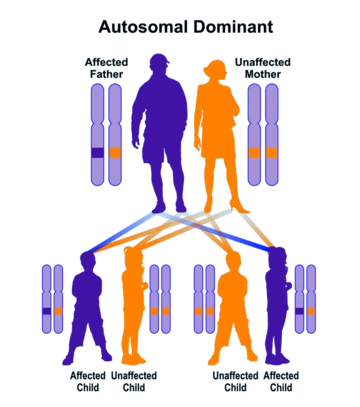
Autosomal dominant inheritance leads to a vertical pattern of transmission
Diagnosis and Prognosis
The correct diagnosis can only be made by your eye doctor after examination of the eyes. Most patients do not require treatment. However, breakdown of the surface can cause severe pain and irritation that can be treated with drops and bandages.
Web Resources
Printer Friendly Version: Ctrl/Cmd+P