


Cornea Plana
Patient Information
Characteristics
Background and History
Cornea plana is one of a large number of rare congenital malformations of the cornea, the clear structure at the front of the eye that functions similar to a windshield. These are usually rare conditions that often cause significant visual problems as they may interfere with the normal passage of light into the eye. Corneal malformations include opacities, abnormal curvature and size, as well as structural abnormalities that can lead to degeneration and progressive loss of vision.
Clinical Correlations
Cornea plana is a condition in which the cornea is flatter than normal. It may be mild and primarily cause farsightedness correctable with glasses or contacts. However, more serious cases may have a central corneal opacity with iris and pupillary abnormalities. Glaucoma sometimes occurs in adults. Visual acuity is highly variable ranging from near normal to severe low vision depending upon the degree of corneal malformation. No systemic abnormalities have been reported.
Genetics
Inheritance
There are several types of corneal plana which may or may not be inherited. Mutations in a gene on chromosome 12 have been found in some but not all patients. The inheritance pattern may be autosomal recessive when two similar mutations (one from each parent) are inherited. Hence the risk for this type is higher when parents are related. Other forms of cornea plana are inherited in an autosomal dominant pattern when a single mutant gene by itself causes disease. In this case the condition appears in a vertical family pattern, having passed through successive generations.
Pedigree
Autosomal dominant
Autosomal dominant disorders require only one mutation for the disease to be expressed. Since an affected parent has two chromosomes, only one of which has the mutant gene, parents can expect that half (50%) of their children will receive that one and inherit the disease. It is common for individuals that inherit the mutation, however, to not have evidence of the disease (nonpenetrance).
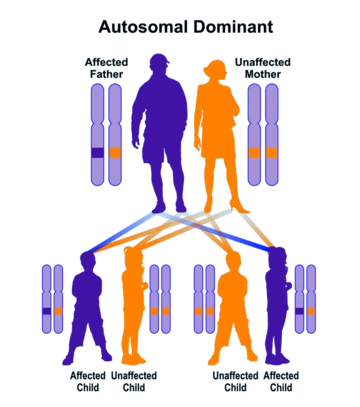
Autosomal dominant inheritance leads to a vertical pattern of transmission
Autosomal recessive
In order for autosomal recessive disorders to be expressed, offspring generally must inherit two mutations, one from each carrier parent. Carriers with only one mutation, such as the parents, do not have clinical disease. Note that carrier parents can expect that 1 in 4 children (25%) will inherit both mutations and have the disorder, 2 in 4 children (50%) will be carriers like their parents, while 1 in 4 children (25%) inherit neither mutation.

In order for autosomal recessive disorders to be expressed, offspring generally must inherit two mutations, one from each carrier parent. Carriers with only one mutation, such as the parents, do not have clinical disease. Note that carrier parents can expect that 1 in 4 children (25%) will inherit both mutations and have the disorder, 2 in 4 children (50%) will be carriers like their parents, while 1 in 4 children (25%) inherit neither mutation.
Diagnosis and Prognosis
An eye doctor can often diagnose this condition by simple inspection but confirmation is usually obtained by measurement of corneal curvature by a technique known as keratometry. Since the thickness of the cornea is often abnormal as well, an eye doctor will often perform pachymetry as well to measure how thick the cornea is. Because glaucoma is a lifelong threat, the pressure inside the eye should be measured and it is important that all patients be monitored periodically throughout life.
Printer Friendly Version: Ctrl/Cmd+P