


Cleft Palate, Psychomotor Retardation, and Distinctive Facial Features
Patient Information
Characteristics
Background and History
Three individuals with these features have recently been reported and the responsible gene mutation has been found.
Clinical Correlations
Children with this condition are born with distinctive facial features and palatal malformations. They are usually mentally and physically delayed with slow maturation of speech and locomotion. Eyebrow and scalp hair anteriorly may be sparse and the lid openings slant downward. The nasal bridge appears widened and the eyes seem to be farther apart. The eyelids droop (ptosis) and there may be misalignment of the eyeballs (strabismus).
The teeth are often malformed with a conical shape and have abnormally wide spacing. Males can have genital anomalies including undescended testicles. The fingers may be short (the thumbs in particular) and tapering. Various nonspecific brain defects have been found on imaging. Children may have poor muscle tone (hypotonia).
Genetics
Inheritance
A gene mutation has been found to be associated with this condition. It is found in a pattern that would be expected to follow an autosomal dominant pattern of inheritance but parent-to-child transmission has not been reported.
Pedigree
Autosomal dominant
Autosomal dominant disorders require only one mutation for the disease to be expressed. Since an affected parent has two chromosomes, only one of which has the mutant gene, parents can expect that half (50%) of their children will receive that one and inherit the disease. It is common for individuals that inherit the mutation, however, to not have evidence of the disease (nonpenetrance).
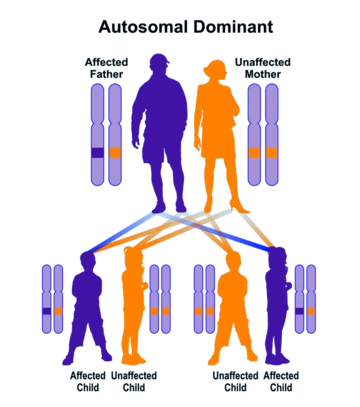
Autosomal dominant inheritance leads to a vertical pattern of transmission
Diagnosis and Prognosis
Diagnosis of this syndrome is complex as most of the features also occur in other conditions. Genotyping is necessary to confirm the diagnosis which can only be suspected clinically. Nothing is known about longevity but quality of life is significantly impaired and most individuals require supportive care.
Printer Friendly Version: Ctrl/Cmd+P