


Choroidal Dystrophy, Central Areolar 2
Patient Information
Characteristics
Background and History
A number of inherited disorders impact a special area of the retina (the light sensing tissue inside the eye) known as the macula. This area contains the highest concentration of cells, known as rods and cones, which respond to light and ultimately transmit these signals to the brain. Consequently, this is the area we use for our sharpest vision and when it is damaged, we suffer vision loss.
Clinical Correlations
The primary area affected by this retinal disorder is the macula which contains the highest concentration of cells known as cones that mediate color vision. Consequently, color vision is abnormal. Vision loss occurs in this condition before night vision problems are noted. Most patients notice progressive vision loss beginning at a mean age of 46 years. Pigmentary changes consisting of a fine granulation can often be seen. The electroretinogram (ERG) responses of the rods and cones can be abnormal before vision changes are noted. Visual field defects consisting of a central blind spot can be demonstrated.
Genetics
Inheritance
This disorder is inherited in a vertical pattern consistent with autosomal dominant transmission. An affected parent transmits this condition with a 50% probability to each of their offspring.
Pedigree
Autosomal dominant
Autosomal dominant disorders require only one mutation for the disease to be expressed. Since an affected parent has two chromosomes, only one of which has the mutant gene, parents can expect that half (50%) of their children will receive that one and inherit the disease. It is common for individuals that inherit the mutation, however, to not have evidence of the disease (nonpenetrance).
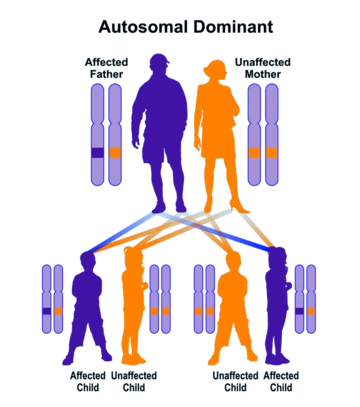
Autosomal dominant inheritance leads to a vertical pattern of transmission
Diagnosis and Prognosis
There are no external signs of this condition and its presence may not be detected until midlife when vision loss is noted. The diagnosis is usually made by an ophthalmologist using an ERG, clinical evaluations, and performing visual field testing. Because of the nonspecific clinical findings, a gene test should be done to determine the exact mutation responsible for the disorder.
There is no known impact on longevity.
Web Resources
Printer Friendly Version: Ctrl/Cmd+P