


CHARGE Syndrome
Patient Information
Characteristics
Background and History
The name of this unusual syndrome is based on the first letters of several prominent features comprising the clinical picture. There is wide variation in the severity of the signs and symptoms ranging from mild to life-threatening.
Clinical Correlations
The majority of patients have small eyes and many have a defect in the pigmented tissues of the eye (e.g., the iris) or even the optic nerve. This may involve one or both eyes and vision depends on the extent of the defect.
Virtually all patients have some growth delay and some have mental difficulties. The face is characteristic with a square configuration, broad forehead, flat midface and a broad nasal bridge. There may be some digital and long bone (limbs) deformities. Often the airways and swallowing tube are incompletely formed leading to breathing and swallowing difficulties. Both the outer and inner ear structures may be malformed and hearing loss is common. The facial muscles may not work properly. Heart malformations are common. The genitalia are usually underdeveloped.
Genetics
Inheritance
The majority of patients are simplex, that is, are not familial. In many of these cases the father is older, a circumstance known to be associated with an increased risk of new mutations. However, parent-to-child transmission does sometimes occur in a pattern consistent with autosomal dominant inheritance. In such families the risk of having another similarly affected child is 50%.
Pedigree
Autosomal dominant
Autosomal dominant disorders require only one mutation for the disease to be expressed. Since an affected parent has two chromosomes, only one of which has the mutant gene, parents can expect that half (50%) of their children will receive that one and inherit the disease. It is common for individuals that inherit the mutation, however, to not have evidence of the disease (nonpenetrance).
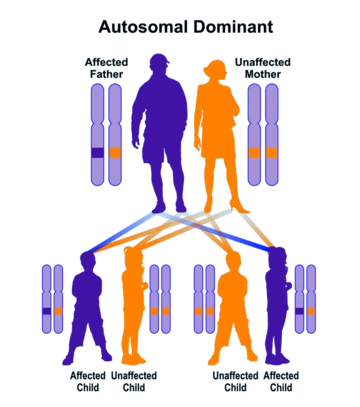
Autosomal dominant inheritance leads to a vertical pattern of transmission
Diagnosis and Prognosis
Depending on the severity of defects, there may be life threatening emergencies especially during infancy. Urgent attention is required for breathing difficulties and heart insufficiency. Feeding difficulties are common and many infants have growth delays. Hearing and vision impairment require assistive treatment. Even under the best of circumstances there is an increased risk of death early in life.
Web Resources
Printer Friendly Version: Ctrl/Cmd+P