


Cataracts, Congenital Cerulean
Patient Information
Characteristics
Background and History
Opacification of the lens in the eye is called a cataract. Cataracts that appear in infants or childhood are generally called congenital or developmental cataracts. They may arise from a variety of causes including various general developmental syndromes, intrauterine infections such as rubella, chromosomal abnormalities, or inherited disorders of metabolism such as galactosemia. About one-fourth appear multiple times within families for which no other cause can be found and these are usually inherited from single gene mutations.
Clinical Correlations
Early onset cataracts that are inherited are often present to some degree at birth but may not be detected until later. This is why all newborns should have a complete eye examination and early detection is important to prevent lazy eye (amblyopia). Inherited forms of cataracts are usually bilateral. These cataracts are often progressive as well so that serial monitoring is required and cataract surgery is performed at an appropriate time. However, it is common for nearly everyone to have small, visually insignificant opacities in the lenses that do not progress and cause no difficulty in seeing. In other words, not all cataracts need to be removed.
Genetics
Inheritance
Simply inherited developmental cataracts are usually inherited in an autosomal dominant pattern but autosomal recessive and X-linked patterns have been reported as well.
Pedigree
Autosomal dominant
Autosomal dominant disorders require only one mutation for the disease to be expressed. Since an affected parent has two chromosomes, only one of which has the mutant gene, parents can expect that half (50%) of their children will receive that one and inherit the disease. It is common for individuals that inherit the mutation, however, to not have evidence of the disease (nonpenetrance).
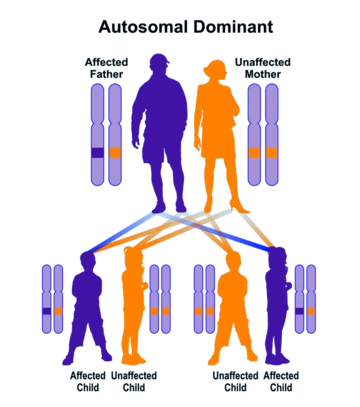
Autosomal dominant inheritance leads to a vertical pattern of transmission
Autosomal recessive
In order for autosomal recessive disorders to be expressed, offspring generally must inherit two mutations, one from each carrier parent. Carriers with only one mutation, such as the parents, do not have clinical disease. Note that carrier parents can expect that 1 in 4 children (25%) will inherit both mutations and have the disorder, 2 in 4 children (50%) will be carriers like their parents, while 1 in 4 children (25%) inherit neither mutation.

In order for autosomal recessive disorders to be expressed, offspring generally must inherit two mutations, one from each carrier parent. Carriers with only one mutation, such as the parents, do not have clinical disease. Note that carrier parents can expect that 1 in 4 children (25%) will inherit both mutations and have the disorder, 2 in 4 children (50%) will be carriers like their parents, while 1 in 4 children (25%) inherit neither mutation.
X-linked recessive, father affected
X-linked disorders are caused by a mutation on the X chromosome and both sexes can pass this to their children. If the mutation is in a recessive gene and carried by the father, he has the disease since his only X chromosome is mutant and he has no normal X to blunt the effects of the abnormal gene. His sons only receive his Y chromosome and thus are all normal. However, all his daughters receive his one and only X chromosome and will be healthy 'carriers'. Thus such males will have no affected children but half their grandsons from those daughters will have the same disease as he does.

X-linked disorders are caused by a mutation on the X chromosome and both sexes can pass this to their children. If the mutation is in a recessive gene and carried by the father, he has the disease since his only X chromosome is mutant and he has no normal X to blunt the effects of the abnormal gene. His sons only receive his Y chromosome and thus are all normal. However, all his daughters receive his one and only X chromosome and will be healthy 'carriers'. Thus such males will have no affected children but half their grandsons from those daughters will have the same disease as he does.
X-linked recessive, carrier mother
X-linked disorders are caused by a mutation on the X chromosome and both sexes can pass this to their children. If the mutation is in a recessive gene and carried by the mother, she usually does not have the disease since the normal X chromosome without the mutation neutralizes the mutation in the abnormal X chromosome. However, half her sons will inherit the mutation-containing X chromosome and therefore have the X-linked disease. Half the daughters will inherit the mutation-bearing X chromosome and are usuallly healthy 'carriers'.

X-linked disorders are caused by a mutation on the X chromosome and both sexes can pass this to their children. If the mutation is in a recessive gene and carried by the mother, she usually does not have the disease since the normal X chromosome without the mutation neutralizes the mutation in the abnormal X chromosome. However, half her sons will inherit the mutation-containing X chromosome and therefore have the X-linked disease. Half the daughters will inherit the mutation-bearing X chromosome and are usuallly healthy 'carriers'.
Diagnosis and Prognosis
Cataracts are diagnosed by eye doctors but it is important that pediatricians and family doctors are involved as well to ensure that they are not part of a more generalized disorder. Timely removal of visually significant cataracts is essential to ensure that infants and children retain good vision into adult life.
Web Resources
Printer Friendly Version: Ctrl/Cmd+P