


Blepharocheilodontic Syndrome 2
Patient Information
Characteristics
Background and History
This is an inherited condition with primary manifestations in the eyelids, teeth, and face.
Clinical Correlations
The eyelids appear too large and there is usually excess skin. The normally single row of eyelashes is duplicated. The eyes appear far apart, the forehead is high, and the hairline seems located too far back.
There is often a cleft lip and palate. The teeth are conically-shaped and some may be missing.
Genetics
Inheritance
This is an autosomal dominant disorder in which the parents can transmit it with a 50% probability.
Pedigree
Autosomal dominant
Autosomal dominant disorders require only one mutation for the disease to be expressed. Since an affected parent has two chromosomes, only one of which has the mutant gene, parents can expect that half (50%) of their children will receive that one and inherit the disease. It is common for individuals that inherit the mutation, however, to not have evidence of the disease (nonpenetrance).
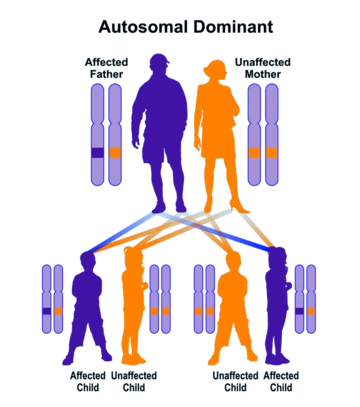
Autosomal dominant inheritance leads to a vertical pattern of transmission
Diagnosis and Prognosis
The physical features may allow for diagnosis at birth. Pediatricians and ophthalmologists will likely collaborate on the diagnosis and care. There is no treatment for the overall condition but the cleft lip and palate can be surgically repaired. Dental evaluations are recommended.
Printer Friendly Version: Ctrl/Cmd+P