


Alport Syndrome (Collagen IV-Related Nephropathies)
Patient Information
Characteristics
Background and History
Alport syndrome was first reported perhaps as early as 1875, but the significance of the association of lethal renal disease and deafness as a familial disease was recognized by AC Alport in 1927 and his name became attached. It is a common disorder and a member of a group of diseases known as collagen IV-related nephropathies.
Clinical Correlations
This is a progressive disorder involving primarily three organs: kidney, eye, and inner ear. The kidney becomes progressively damaged leading to eventual failure manifest by red blood cells in the urine. Hearing loss begins in childhood resulting in deafness in many individuals although some adults retain some hearing. High frequency loss is the earliest sign and can be detected in young children. The lens and retina are often normal in childhood but cataracts and a characteristic deformity (lenticonus) are seen as the disease progresses. There is a tendency for cells on the surface of the cornea to spontaneously detach causing painful scratches that are slow to heal. The retina has a characteristic ‘speckled’ appearance although this has little impact on vision.
In general, males are more severely affected but even in X-linked disease carrier females can have symptoms.
Genetics
Inheritance
Alport syndrome is not a single disease as evidenced by the fact that there are at least three patterns of inheritance: X-linked in which males are primarily involved, autosomal recessive, and autosomal dominant. However, all affected individuals have a defect in a component of connective (fibrous) tissue that is an important constituent of tissue membranes. The risk of recurrence, of course, depends upon the pattern of inheritance.
Pedigree
Autosomal dominant
Autosomal dominant disorders require only one mutation for the disease to be expressed. Since an affected parent has two chromosomes, only one of which has the mutant gene, parents can expect that half (50%) of their children will receive that one and inherit the disease. It is common for individuals that inherit the mutation, however, to not have evidence of the disease (nonpenetrance).
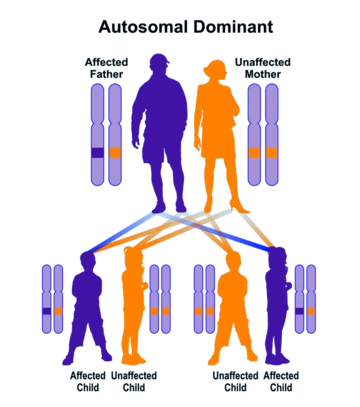
Autosomal dominant inheritance leads to a vertical pattern of transmission
Autosomal recessive
In order for autosomal recessive disorders to be expressed, offspring generally must inherit two mutations, one from each carrier parent. Carriers with only one mutation, such as the parents, do not have clinical disease. Note that carrier parents can expect that 1 in 4 children (25%) will inherit both mutations and have the disorder, 2 in 4 children (50%) will be carriers like their parents, while 1 in 4 children (25%) inherit neither mutation.

In order for autosomal recessive disorders to be expressed, offspring generally must inherit two mutations, one from each carrier parent. Carriers with only one mutation, such as the parents, do not have clinical disease. Note that carrier parents can expect that 1 in 4 children (25%) will inherit both mutations and have the disorder, 2 in 4 children (50%) will be carriers like their parents, while 1 in 4 children (25%) inherit neither mutation.
X-linked recessive, carrier mother
X-linked disorders are caused by a mutation on the X chromosome and both sexes can pass this to their children. If the mutation is in a recessive gene and carried by the mother, she usually does not have the disease since the normal X chromosome without the mutation neutralizes the mutation in the abnormal X chromosome. However, half her sons will inherit the mutation-containing X chromosome and therefore have the X-linked disease. Half the daughters will inherit the mutation-bearing X chromosome and are usuallly healthy 'carriers'.

X-linked disorders are caused by a mutation on the X chromosome and both sexes can pass this to their children. If the mutation is in a recessive gene and carried by the mother, she usually does not have the disease since the normal X chromosome without the mutation neutralizes the mutation in the abnormal X chromosome. However, half her sons will inherit the mutation-containing X chromosome and therefore have the X-linked disease. Half the daughters will inherit the mutation-bearing X chromosome and are usuallly healthy 'carriers'.
X-linked recessive, father affected
X-linked disorders are caused by a mutation on the X chromosome and both sexes can pass this to their children. If the mutation is in a recessive gene and carried by the father, he has the disease since his only X chromosome is mutant and he has no normal X to blunt the effects of the abnormal gene. His sons only receive his Y chromosome and thus are all normal. However, all his daughters receive his one and only X chromosome and will be healthy 'carriers'. Thus such males will have no affected children but half their grandsons from those daughters will have the same disease as he does.

X-linked disorders are caused by a mutation on the X chromosome and both sexes can pass this to their children. If the mutation is in a recessive gene and carried by the father, he has the disease since his only X chromosome is mutant and he has no normal X to blunt the effects of the abnormal gene. His sons only receive his Y chromosome and thus are all normal. However, all his daughters receive his one and only X chromosome and will be healthy 'carriers'. Thus such males will have no affected children but half their grandsons from those daughters will have the same disease as he does.
Diagnosis and Prognosis
The diagnosis is based on the association of kidney disease, ocular findings, and deafness. Mutations in the connective tissue genes provide confirmation but are not always present. Kidney failure is the most serious threat to longevity and a kidney transplant may be required. Cataract surgery may also be required if lens abnormalities interfere with light reaching the retina.
Web Resources
Printer Friendly Version: Ctrl/Cmd+P