


OMIM ID:
Wagner Syndrome
Alternate Names
Defective Genes
Clinical Characteristics
Ocular Features
This is one of several hereditary vitreoretinal degenerative disorders in which vitreous degeneration occurs and the risk of retinal detachment is high (others being Goldmann-Favre [268100], Stickler [609508, 108300], and Marshall [154780] syndromes). An optically empty central vitreous is a common feature in this heterogeneous group. Other reported ocular findings in Wagner syndrome include perivascular sheathing and pigmentation, progressive chorioretinal dystrophy, ectopic fovea with pseudoexotropia, tractional retinal detachments, glaucoma (neovascular in some), and vitreous veils with fibrillar condensation. Cataracts occur in virtually all patients over the age of 45 years. The ERG in the majority of patients shows elevated rod and cone thresholds on dark adaptation (63%) and subnormal b-wave amplitudes (87%). Mild difficulties in dim light are noted by some patients. Visual acuities are highly variable ranging from normal in many patients to blindness in others. Peripheral visual fields may be severely constricted.
Systemic Features
Cleft palate has been seen in some patients but these likely had Stickler syndrome (609508, 108300, 604841 ) since hearing loss along with other joint and skeletal manifestations are absent. Further, cases reported to have Wagner syndrome with palatoschisis have not been genotyped so it is likely that they were misdiagnosed.
Genetics
Inheritance
Wagner syndrome results from a mutation in the VCAN gene encoding versican (5q14.3), a chondroitin sulfate proteoglycan-2 found in the vitreous among other tissues. It is an autosomal dominant disorder. It has been proposed that erosive vitreoretinopathy (ERVR) (143200) is allelic to Wagner’s syndrome but it may also simply be a variable expression of the same disorder. Both map to 5q13-q14. Overlapping of clinical signs and symptoms among hereditary disorders of vitreoretinal degeneration has created some confusion in their classification but this will hopefully be clarified as more families are genotyped. Stickler syndrome (609508, 108300), for example, is known to be caused by a mutation in an entirely different gene (COL2A1) on a different chromosome.
Snowflake type vitreoretinal degeneration (193230), another autosomal dominant disorder, has a superficial resemblance but mutations in a different gene (KCNJ13) are responsible.
Pedigree
Autosomal dominant
Autosomal dominant disorders require only one mutation for the disease to be expressed. Since an affected parent has two chromosomes, only one of which has the mutant gene, parents can expect that half (50%) of their children will receive that one and inherit the disease. It is common for individuals that inherit the mutation, however, to not have evidence of the disease (nonpenetrance).
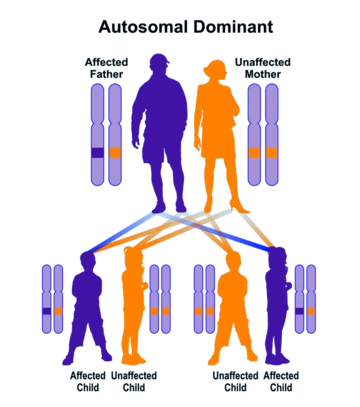
Autosomal dominant inheritance leads to a vertical pattern of transmission