


OMIM ID:
Von Hippel-Lindau Syndrome
Alternate Names
Defective Genes
Clinical Characteristics
Ocular Features
Retinal angiomas are a feature of this syndrome, occurring in up to 70% of patients and often diagnosed by about age 25 years. These hemangioblastomas are often connected to prominent arterioles and venules indicative of their vascular nature. Capillary hamartomas located on or near the optic nerve may mimic papilledema or papillitis. However, they may also occur throughout the retina and visual morbidity often results from secondary damage due to hemorrhage, exudates, and traction on the retina. When they are bilateral and multicentric the diagnosis of VHL is highly likely. Patients with VHL tend to develop such tumors at a younger age and have worse visual outcomes than those in patients without VHL. The impact on vision is responsible for initial presentation in many patients.
Systemic Features
Clinical symptoms typically have their onset during the second decade of life. These commonly (in 35% of patients) result from the presence of a cerebellar hemangioblastoma while overall more than 60% eventually develop this malignancy. Up to 40% of patients develop renal cell carcinomas and these are a major cause of death. However, benign and malignant tumors may appear in many organs including the adrenal glands, pancreas, and spinal cord. Pheochromocytomas occur in 20-35% of individuals and may be bilateral and multifocal. These can induce an erythrocythemia. Endolymphatic sac tumors occur in about 10% of patients. Cystic lesions are often associated with the tumors, especially in the pancreas.
Several subtypes have been proposed based on the pattern of malignancies and the types of mutations found in patients.
Genetics
Inheritance
Pedigree
Autosomal dominant
Autosomal dominant disorders require only one mutation for the disease to be expressed. Since an affected parent has two chromosomes, only one of which has the mutant gene, parents can expect that half (50%) of their children will receive that one and inherit the disease. It is common for individuals that inherit the mutation, however, to not have evidence of the disease (nonpenetrance).
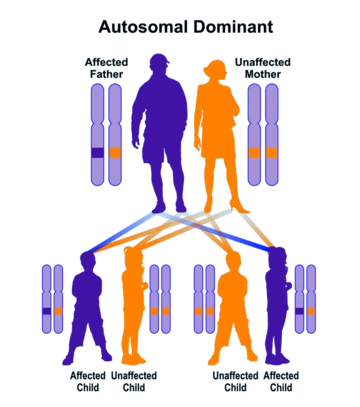
Autosomal dominant inheritance leads to a vertical pattern of transmission