


OMIM ID:
Vitreoretinal Degeneration, Snowflake Type
Alternate Names
Defective Genes
Clinical Characteristics
Ocular Features
The retina and vitreous are primarily affected in this disorder. The age of onset is unknown but characteristic signs can be seen early in the second decade of life. Early changes include thickening of the cortical vitreous and white dots in the superficial layers of the retina. The latter are minute yellow-white crystalline deposits more common in the peripheral retina. Many (83%) patients have early onset cataracts. Corneal guttae are common (80% of patients). The vitreous undergoes fibrillar degeneration with liquefaction and eventually appears optically empty. Many patients experience symptoms of floaters. The vitreous changes most closely resemble that seen in Wagner syndrome (143200) but with important differences. In the latter disorder the vitreous changes are membranous, the retinal changes are deeper in location, RPE changes are evident, the choroid and RPE are involved, and the risk of retinal detachment is much higher. Only 21% of patients with snowflake vitreoretinal degeneration have retinal detachments compared with about 50% in Wagner syndrome. Retinal vasculature change such as perivascular sheathing and attenuation of arterioles may be seen in both disorders but occur far less commonly in snowflake degeneration.
Based on lack of visual symptoms, the photoreceptors are minimally involved. Electrophysiologic studies reveal an elevated dark adaptation and reduced scotopic B waves. Most patients retain excellent vision. However, the optic nerve may have a waxy pallor and frequently appears flat and lacks a visible cup.
Systemic Features
None.
Genetics
Inheritance
Snowflake vitreoretinal degeneration is an autosomal dominant disorder. Heterozygous missense mutations have been found in KCNJ13 (2q37) in a single family. Mutations in the same gene have been identified in rare cases of Leber congenital amaurosis.
Pedigree
Autosomal dominant
Autosomal dominant disorders require only one mutation for the disease to be expressed. Since an affected parent has two chromosomes, only one of which has the mutant gene, parents can expect that half (50%) of their children will receive that one and inherit the disease. It is common for individuals that inherit the mutation, however, to not have evidence of the disease (nonpenetrance).
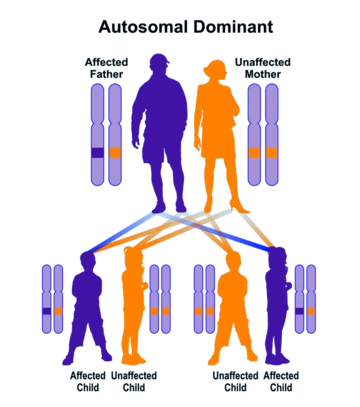
Autosomal dominant inheritance leads to a vertical pattern of transmission