


OMIM ID:
Spinocerebellar Ataxia 38
Alternate Names
Defective Genes
Clinical Characteristics
Ocular Features
Gaze-evoked nystagmus is present with the onset of ataxia. Some patients report diplopia. Saccadic movements are described as slow. Visual acuities and the appearance of the retina and optic nerve have not been reported.
Systemic Features
Truncal and gait ataxia are generally evident by age 40 years and progressively worsen. Mobility requires assistance usually by age 50. Mild sensory complaints are present in the majority of individuals. Dysarthria is often a feature.
MRI reveals cerebellar atrophy with no evidence of brainstem involvement.
Genetics
Inheritance
Heterozygous mutations in the ELOVL5 gene (6p12.1) are responsible for this autosomal dominant disorder. The gene is a member of family that encodes elongases that synthesize long chain fatty acids in the endoplasmic reticulum.
Pedigree
Autosomal dominant
Autosomal dominant disorders require only one mutation for the disease to be expressed. Since an affected parent has two chromosomes, only one of which has the mutant gene, parents can expect that half (50%) of their children will receive that one and inherit the disease. It is common for individuals that inherit the mutation, however, to not have evidence of the disease (nonpenetrance).
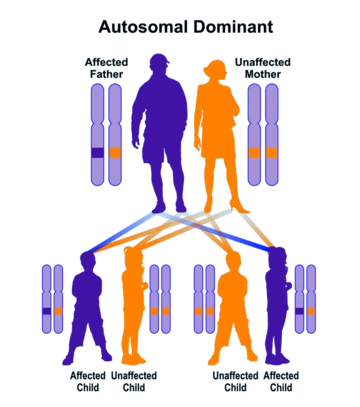
Autosomal dominant inheritance leads to a vertical pattern of transmission