


OMIM ID:
Spinocerebellar Ataxia 3
Alternate Names
Defective Genes
Clinical Characteristics
Ocular Features
External ophthalmoplegia in some form is usually present and there may be a supranuclear component. Smooth horizontal movements are impaired and saccades are dysmetric. Gaze-evoked nystagmus is a common finding. The eyes are often described as ‘bulging’ and this has been attributed to eyelid retraction. With time the abnormal saccadic movements slow resulting in ophthalmoparesis with restriction of upgaze.
Systemic Features
This form of spinocerebellar ataxia is considered to be the most frequent. It is a progressive disease in all aspects which accounts for some of the considerable clinical heterogeneity reported. Onset is likewise highly variable depending upon the number of repeats but usually sometime between the second to fifth decades. In a large cohort of Azorean individuals the mean age of onset was reported to be 37 years.
An unsteady gait, dysarthric speech, general clumsiness, and diplopia are among the early symptoms. Nystagmus, spasticity, and various autonomic signs including reduced bladder control may also be noted. Chronic pain, sleep disturbances, impaired mental functioning, and memory deficits are often present and some authors have labelled these as indicative of dementia.
Virtually all clinical signs progress with ambulation difficulties requiring the need for assistive devices about a decade after the onset of disease. Eventually signs of brain stem involvement appear with facial atrophy, perioral twitching, tongue fasciculations and atrophy, and dysphagia. Some degree of peripheral polyneuropathy with muscle wasting and loss of sensation are often present. Tremors and other signs of Parkinsonism may be present. Dystonic movements are often seen.
Imagining of the brain has revealed pontocerebellar atrophy and enlargement of the 4th ventricle but this is variable. Nerve conduction studies documents involvement of the sensory nerves. Neuropathologic studies show widespread neuronal loss in the CNS and spinal cord.
Genetics
Inheritance
This is considered to be an autosomal dominant disorder caused by an excess of heterozygous trinucleotide repeats in the ataxin3 gene (14q32) encoding glutamine. The number in normal individuals is up to 44 repeats whereas patients with SCA3 have 52-86 repeats. However, clinical signs of SCA3 have been found in patients with as few as 45 glutamine repeats.
Pedigree
Autosomal dominant
Autosomal dominant disorders require only one mutation for the disease to be expressed. Since an affected parent has two chromosomes, only one of which has the mutant gene, parents can expect that half (50%) of their children will receive that one and inherit the disease. It is common for individuals that inherit the mutation, however, to not have evidence of the disease (nonpenetrance).
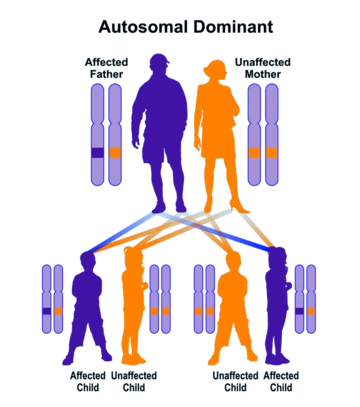
Autosomal dominant inheritance leads to a vertical pattern of transmission