


Clinical Characteristics
Ocular Features
The corneas and anterior chambers were normal in the son but the lenses were small and spherical and had colobomatous defects. The father developed a retinal detachment in one eye and elevated intraocular pressure. The morphology of the lenses in the father is unknown.
Systemic Features
The diaphyses of the long bones are thickened with relative sparing of the small bones in the extremities. The epiphyses become more irregular later in life. The vertebrae are deformed with flattening. The result is brachymelia and moderately severe dwarfism. Pigeon breast deformity can be present.
Genetics
Inheritance
A father and son have been reported with this combination of findings suggesting autosomal dominant inheritance. No locus or mutation has been identified.
Pedigree
Autosomal dominant
Autosomal dominant disorders require only one mutation for the disease to be expressed. Since an affected parent has two chromosomes, only one of which has the mutant gene, parents can expect that half (50%) of their children will receive that one and inherit the disease. It is common for individuals that inherit the mutation, however, to not have evidence of the disease (nonpenetrance).
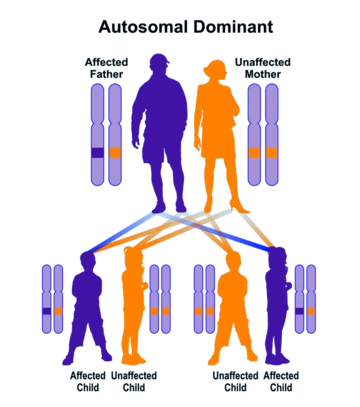
Autosomal dominant inheritance leads to a vertical pattern of transmission