


OMIM ID:
Spastic Ataxia 7, with Miosis
Alternate Names
Defective Genes
Clinical Characteristics
Ocular Features
Several large pedigrees have been reported in which both males and females had congenital miosis and decreased pupillary light responses. The pupils are about 2 mm in size and have been described as 'fixed' since they do not dilate in low light or constrict in bright light. They also do not respond well to mydriatics. Several individuals also had nystagmus and dysconjugate eye movements.
Optic atrophy is not a consistent feature although several in the original reported family were reported to have this feature which is often found in other spastic ataxia disorders, such as Friedreich's ataxia (229300).
Systemic Features
Ataxia in gait and limb motion with pyramidal signs is part of this disorder. Deep tendon reflexes are increased and plantar responses are often extensor in direction. Both pyramidal signs and the ataxia progress little. Affected individuals begin walking late and often have slurred speech. The IQ's in one family were measured to be less than 90. CT scans have not revealed cerebellar atrophy.
Genetics
Inheritance
This condition is likely inherited in an autosomal dominant pattern based on one pedigree with 21 members in 4 generations and another with an affected mother and 3 of 5 affected children. Nothing is known about the locus responsible.
Optic atrophy is also found in autosomal recessive SPAX4 (613672) and in an ill-defined autosomal recessive form of spastic ataxia with mental retardation (270500).
Pedigree
Autosomal dominant
Autosomal dominant disorders require only one mutation for the disease to be expressed. Since an affected parent has two chromosomes, only one of which has the mutant gene, parents can expect that half (50%) of their children will receive that one and inherit the disease. It is common for individuals that inherit the mutation, however, to not have evidence of the disease (nonpenetrance).
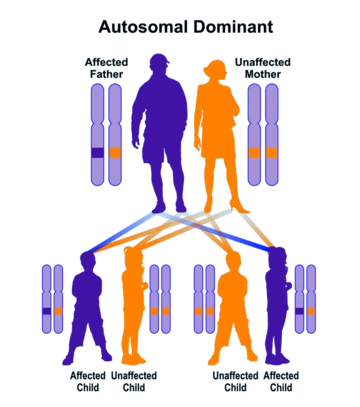
Autosomal dominant inheritance leads to a vertical pattern of transmission