


OMIM ID:
Schurrs-Hoeijmakers Syndrome
Alternate Names
Defective Genes
Clinical Characteristics
Ocular Features
Mild structural variants are common among the periocular structures. There is marked hypertelorism in many individuals, the eyebrows are full and highly arched, the eyelashes are long, and the lid fissures slant downward. Ptosis is often evident. Myopia, nystagmus, and strabismus are frequently noted. Colobomas have been reported.
Systemic Features
There is general psychomotor delay in development. Intellectual disability (with IQs in the 50s) and hypotonia are common. Speech is poor and sometimes absent. Behavioral anomalies such as aggression and features of autism have been reported. The anterior hairline is low, the mouth is wide with downturned corners, the nose is bulbous, the ears are large and low-set, and the teeth are often widely-spaced. Cryptorchidism is common among males.
Renal and cardiac defects are common. Brain MRIs often show cerebellar hypoplasia, enlarged ventricles, and nonspecific white matter changes.
Genetics
Inheritance
No treatment for the general disorder has been published. Physical and speech therapy might be helpful
Pedigree
Autosomal dominant
Autosomal dominant disorders require only one mutation for the disease to be expressed. Since an affected parent has two chromosomes, only one of which has the mutant gene, parents can expect that half (50%) of their children will receive that one and inherit the disease. It is common for individuals that inherit the mutation, however, to not have evidence of the disease (nonpenetrance).
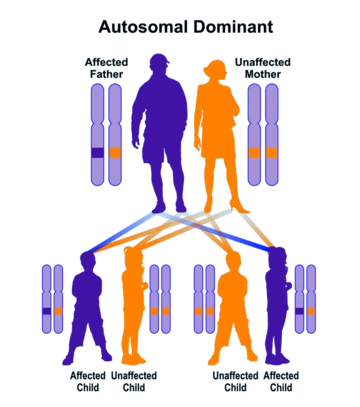
Autosomal dominant inheritance leads to a vertical pattern of transmission