


OMIM ID:
Rubinstein-Taybi Syndrome 2
Alternate Names
Defective Genes
Clinical Characteristics
Ocular Features
Highly-arched and bushy eyebrows are often seen. The lashes are long and bushy and lid fissures tend to slope downward.
The ocular phenotype has not been fully described no doubt due to the rarity of cases. Individuals with type 1 (RSTS1) have been described with congenital glaucoma, nystagmus, corneal abnormalities of shape (such as keratoglobus, sclerocornea, megalocornea), pigmentary retinopathy, and VEP evidence of rod and cone dysfunction have been described.
Systemic Features
The phenotype of RSTS2 is more variable than the somewhat similar RSTS1. Less than 10% of individuals with Rubinstein-Taybi syndrome have type 2 while over 50% have type 1. The facial dysmorphism nay be less severe in RSTS2.
Mild to moderate intellectual disability with psychosocial problems such as autism is nearly universal. Microcephaly, a broad nasal bridge, a beaked nose, high-arched palate and some degree of micrognathia are characteristic. The lower lip often appears ‘pouty’ and protrudes beyond the upper lip while the hard palate is highly arched. Pregnancy may be complicated by pre-eclampsia and growth restriction. Swallowing and feeding issues are common. Syndactyly is often present and there is considerable variability in the size of the toes and thumbs. Some patients with RSTS2 do not have evidence of the classic broad thumbs and toes characteristic of RSTS1.
Genetics
Inheritance
Heterozygous mutations in EP300 (22q13.2) have been found in this condition. Virtually all cases occur de novo. Rubinstein-Taybi Syndrome 1 (180849) is a phenotypically similar disorder resulting from a different mutation (CREBBP).
Pedigree
Autosomal dominant
Autosomal dominant disorders require only one mutation for the disease to be expressed. Since an affected parent has two chromosomes, only one of which has the mutant gene, parents can expect that half (50%) of their children will receive that one and inherit the disease. It is common for individuals that inherit the mutation, however, to not have evidence of the disease (nonpenetrance).
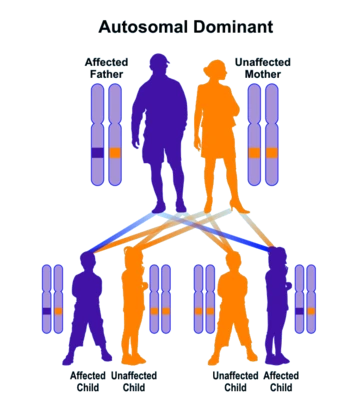
Autosomal dominant inheritance leads to a vertical pattern of transmission