


OMIM ID:
Révész Syndrome
Alternate Names
Defective Genes
Clinical Characteristics
Ocular Features
This is likely a severe form of dyskeratosis congenita with an exudative retinopathy in addition to the usual lid deformities, corneal opacification, conjunctival scarring. The exudates are often present in early childhood, and may be of sufficient volume to present as leukocoria mimicking a retrolental mass. The exudates extend through nearly all layers of the retina and are said to resemble Coats retinopathy. Vitreous hemorrhage and opacification has also been reported. Severe vision loss and blindness may occur depending on the degree of retinal and vitreous disease.
Systemic Features
Patients with Révész syndrome have cerebral calcifications, and hypoplasia of the cerebellum in addition to mild signs of dyskeratosis congenita such as a reticulated skin pattern, nail dysplasia, and oral leukoplakia. Ataxia is a prominent sign but is not present in all patients. Bone marrow failure with pancytopenia and a high risk of malignancies, however, are serious problems. Aplastic anemia and neutropenia may present in early childhood while other signs may not appear until late childhood. Sparse hair, intrauterine growth retardation and low birth weight are also features.
Few patients with Révész syndrome have been reported and the clinical features have not been fully delineated. It is important to note that there is a large amount of clinical variation among patients.
Genetics
Inheritance
Heterozygous mutations in the TINF2 gene (14q12) have been found in Révész syndrome. Mutations in the same gene have also been found in the autosomal dominant form of dyskeratosis congenita (613990) suggesting that the two disorders, if distinct, are allelic.
Pedigree
Autosomal dominant
Autosomal dominant disorders require only one mutation for the disease to be expressed. Since an affected parent has two chromosomes, only one of which has the mutant gene, parents can expect that half (50%) of their children will receive that one and inherit the disease. It is common for individuals that inherit the mutation, however, to not have evidence of the disease (nonpenetrance).
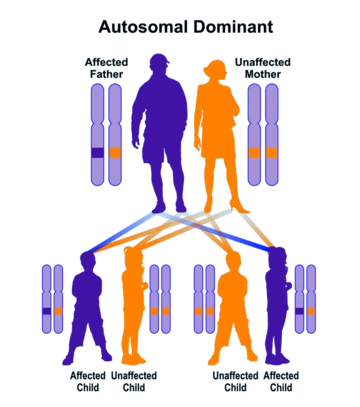
Autosomal dominant inheritance leads to a vertical pattern of transmission