


OMIM ID:
Retinitis Pigmentosa 47
Alternate Names
Defective Genes
Clinical Characteristics
Ocular Features
Onset of night blindness and field constriction symptoms occur during the 4th and 5th decades of life. Pigmentary abnormalities of the retina are the hallmark of this condition. Retinal thinning, bone spicule pigmentation, vascular attenuation, optic disc pallor, and pigmentary atrophy have all been noted.
In patients with the autosomal dominant form of this disease, rod function is severely impaired or absent as evidenced by ERG studies. Cone responses are often reduced on an age-related basis and in the range of 85-95% below normal. As expected, dark-adapted visual thresholds are elevated and visual fields are restricted peripherally. Loss of vision is age-related but some individuals can retain acuities of 20/35 to 20/40 into their sixth decade. It is more common for acuities to be in the range of 20/200 to 20/400 later in life.
Systemic Features
No systemic disease is associated with this disorder.
Genetics
Inheritance
Mutations in the SAG gene (2q37) are responsible for this form of RP. Both autosomal recessive and autosomal dominant modes of inheritance have been reported.
In one family with homozygous mutations a sib had features of Oguchi disease which also results from homozygous mutations in SAG.
Among Hispanic families in the southwestern US, heterozygous mutations in SAG are a common cause of autosomal dominant retinitis pigmentosa.
Pedigree
Autosomal dominant
Autosomal dominant disorders require only one mutation for the disease to be expressed. Since an affected parent has two chromosomes, only one of which has the mutant gene, parents can expect that half (50%) of their children will receive that one and inherit the disease. It is common for individuals that inherit the mutation, however, to not have evidence of the disease (nonpenetrance).
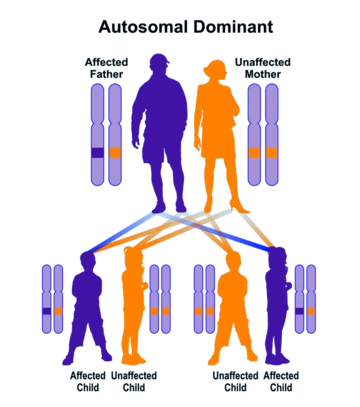
Autosomal dominant inheritance leads to a vertical pattern of transmission
Autosomal recessive
In order for autosomal recessive disorders to be expressed, offspring generally must inherit two mutations, one from each carrier parent. Carriers with only one mutation, such as the parents, do not have clinical disease. Note that carrier parents can expect that 1 in 4 children (25%) will inherit both mutations and have the disorder, 2 in 4 children (50%) will be carriers like their parents, while 1 in 4 children (25%) inherit neither mutation.

In order for autosomal recessive disorders to be expressed, offspring generally must inherit two mutations, one from each carrier parent. Carriers with only one mutation, such as the parents, do not have clinical disease. Note that carrier parents can expect that 1 in 4 children (25%) will inherit both mutations and have the disorder, 2 in 4 children (50%) will be carriers like their parents, while 1 in 4 children (25%) inherit neither mutation.