


Clinical Characteristics
Ocular Features
The diameter of retinal arterioles and their degree of tortuosity are continuous metrics without specific endpoints. However, examination of the retinal vasculature can identify a set of patients in which the arterioles are strikingly tortuous. It is most evident in second and third order vessels. In such individuals retinal hemorrhages may occur following mild trauma and exercise. They are usually located in the posterior pole and may account for reported episodes of temporary vision loss if located in the foveal and parafoveal areas. No vascular leakage is seen on fluorescein angiography. The retinal hemorrhages usually resolve without permanent damage. The vascular tortuosity seems to have its onset in the first two decades of life and has been described as progressive.
Systemic Features
Increased tortuosity of capillaries in the nail beds can be seen and some individuals have hematuria.
The phenotype in this condition is variable and seems to be specific to individual families. There are families in which extraocular disease has been ruled out whereas in other families there may be small vessel disease in the brain, and yet other families in which nephropathy, muscle cramps, and aneurysms occur with the retinal arteriolar tortuosity. Patients with systemic vascular disease frequently have evidence of leukoencephalopathy on brain scans. There is a significant risk of major vascular accidents in the central nervous system.
Genetics
Inheritance
Heterozygous mutations in the COL4A1 gene (13q34) have been identified in families with simple retinal arteriolar tortuosity. The gene product is a component of type IV collagen which is found in basement membranes throughout the body, including blood vessels.
Mutations in COL4A1 have also been found in the multisystem disease known as HANAC (Hereditary Angiopathy with Nephropathy, Aneurysm and Cramps) (611773) in which tortuosity of the retinal arterioles is also seen.
Vascular tortuosity is also a feature of Fabry disease (301500) and Williams syndrome (194050).
Pedigree
Autosomal dominant
Autosomal dominant disorders require only one mutation for the disease to be expressed. Since an affected parent has two chromosomes, only one of which has the mutant gene, parents can expect that half (50%) of their children will receive that one and inherit the disease. It is common for individuals that inherit the mutation, however, to not have evidence of the disease (nonpenetrance).
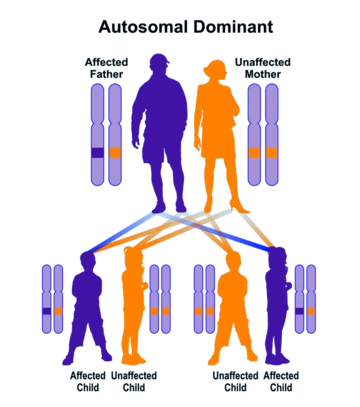
Autosomal dominant inheritance leads to a vertical pattern of transmission