


Clinical Characteristics
Ocular Features
Nystagmus and limited extraocular movements are usually present in PRLTS1. Optic atrophy and poor visual acuity have been reported. Ptosis may be present. The clinical manifestations are variable among and within the types. Rod dysfunction and ‘retinal atrophy’ were reported in one patient. The majority of patients have had only limited ocular evaluations.
Systemic Features
This is a sex-influenced condition in which both sexes have a sensorineural hearing deficit and neurodegenerative disease (both central and peripheral) but only the females have gonadal dysgenesis. Motor development is often delayed and ataxia along with a peripheral sensory neuropathy and a variable degree of limb weakness can be present. Learning difficulties, cognitive decline, and frank mental retardation are frequently described. The cerebellum may be atrophic.
There is considerable variability in the clinical signs.
Genetics
Inheritance
The combination of hearing loss in males and females, ovarian dysgenesis in females, and variable neurologic signs including external ophthalmoplegia and sometimes optic atrophy is known as Perrault syndrome. The ocular movement abnormalities are seen primarily in PRLTS1.
At least 5 unique mutations have been found accounting for types PRLTS1-5. PRLTS1 (233400) results from mutations in HSD17B4 (5q23.1), type PRLTS2 (614926) is caused by mutations in the HARS2 gene, PPRLTS3 (614129) by mutations in the CLPP gene, PRLTS4 (615300) by mutations in the LARS2 gene, and PRLTS5 (616138) by mutations in C10orf2 (listed in this database as External Ophthalmoplegia, C10orf2, and mtDNA mutations,.
The inheritance pattern among different types may be autosomal recessive or autosomal dominant.
Pedigree
Autosomal dominant
Autosomal dominant disorders require only one mutation for the disease to be expressed. Since an affected parent has two chromosomes, only one of which has the mutant gene, parents can expect that half (50%) of their children will receive that one and inherit the disease. It is common for individuals that inherit the mutation, however, to not have evidence of the disease (nonpenetrance).
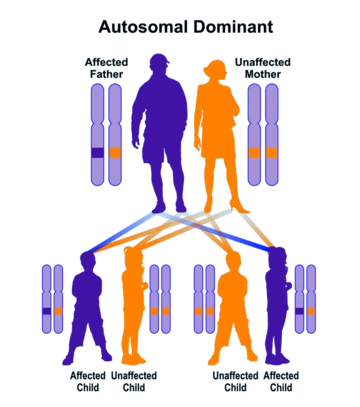
Autosomal dominant inheritance leads to a vertical pattern of transmission
Autosomal recessive
In order for autosomal recessive disorders to be expressed, offspring generally must inherit two mutations, one from each carrier parent. Carriers with only one mutation, such as the parents, do not have clinical disease. Note that carrier parents can expect that 1 in 4 children (25%) will inherit both mutations and have the disorder, 2 in 4 children (50%) will be carriers like their parents, while 1 in 4 children (25%) inherit neither mutation.

In order for autosomal recessive disorders to be expressed, offspring generally must inherit two mutations, one from each carrier parent. Carriers with only one mutation, such as the parents, do not have clinical disease. Note that carrier parents can expect that 1 in 4 children (25%) will inherit both mutations and have the disorder, 2 in 4 children (50%) will be carriers like their parents, while 1 in 4 children (25%) inherit neither mutation.